
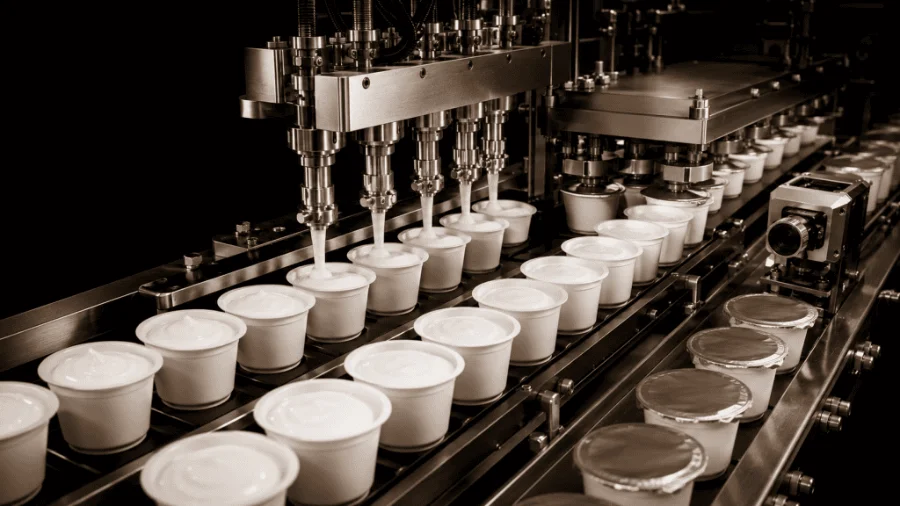
Dairy is not one packaging problem. Milk is a high-speed liquid fill. Yogurt is a viscous fill that often carries inclusions. Cheese is a barrier and shelf-life problem before it is a filling problem. Producers who run more than one of these usually discover that the constraint is not machine speed but how well the line handles the transitions between them.
This guide covers what to establish per product category before you shortlist equipment.
Three Categories, Three Different Machines
| Category | The dominant constraint | What that means when specifying |
|---|---|---|
| Milk | Speed and contamination control | Precision liquid filling, aseptic or hygienic design, high sustained throughput |
| Yogurt | Viscosity and inclusions | Dosing accuracy with fruit or granola, reliable foil sealing |
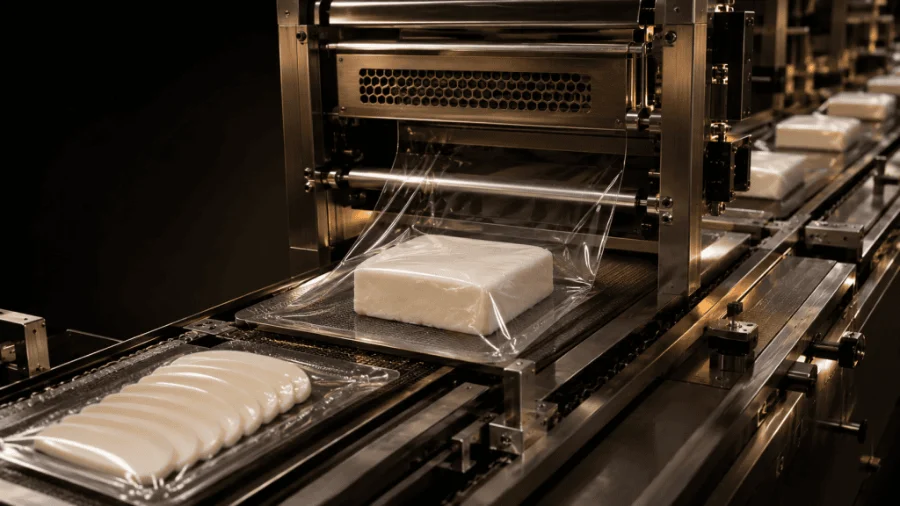
| Cheese | Barrier and shelf life | Seal integrity and film barrier performance over the whole shelf life |
| Cream, butter, ghee | Fat content and temperature | Fill behaviour changes with temperature; specify at your actual process temp |
If you run two or more of these on one site, the question to answer early is whether you are buying one flexible line or two specialised ones. Flexible sounds cheaper until you count the changeover hours it costs every week.
Precision Filling Is the Recurring Requirement
Across every dairy category, fill precision is where equipment either earns its cost or quietly loses money. Overfill by a small margin on every unit and the giveaway compounds across millions of units a year. Underfill and you have a compliance problem.
Ask for the accuracy figure at your product temperature and viscosity, sustained across a full run rather than measured on a short demonstration. For yogurt with inclusions, ask specifically for the figure with inclusions running – nozzles sized for smooth product behave differently once fruit is in the stream.
Contamination Control Shapes the Whole Line
Dairy carries strict sanitation requirements, and they shape line layout and changeover procedure rather than sitting in a compliance folder. Look for FDA and USDA compliant, ISO 9001 and CE certified equipment as a starting point, then get specific about cleaning: full washdown duration, which parts come off without tools, and whether cleaning between products is a rinse or a strip-down.
On short-shelf-life chilled dairy, cleaning time is production time. It belongs in your capacity calculation, not in a separate operational bucket.
Cold Chain Changes How Packaging Behaves
Equipment specified in a dry, room-temperature test hall can behave differently in a chilled production environment. Condensation affects label adhesion and can affect seal reliability. If your line runs cold, insist on seeing the machine run cold rather than accepting a temperate-room demonstration.
The same applies to e-commerce formats. Packaging that survives a retail pallet is not automatically packaging that survives a parcel network, and if direct-to-consumer is on your roadmap it changes the seal and format specification.
Sizing Against Your Own Numbers
Take your daily unit target, divide by the shift hours you will genuinely run, then subtract changeover and washdown before you compare any machine.
| System | Throughput | Typical dairy fit |
|---|---|---|
| Cup Fill & Seal | 24-96 cups/min | Yogurt cups and tubs, cream and dessert pots |
| Form Fill & Seal | 100-300 units/min | Higher-volume runs where the pack is formed in line |
| Tray Sealers | 40-180 trays/min | Cheese portions and multipack presentations |
Automating packaging typically takes 40-80% out of packaging labour, with payback usually landing between 8 and 14 months. On multi-category dairy sites the consistency gain often matters more than the labour one, because retail expects identical presentation across a whole run.
Before You Commit
- What fill accuracy holds at my product temperature, across a full run?
- What does a changeover between product categories actually take, start to restart?
- Which parts come off for cleaning without tools?
- How does the line detect a failed seal before product ships?
- Can I see it run my product, at my temperature?
The temperature question separates vendors quickly on dairy. A demonstration with ambient test media tells you very little about how a chilled line will behave in week three.
Where Dairy Lines Actually Lose Capacity
When a dairy line underperforms its rated speed, the cause is rarely the filler. It is almost always one of four things, and it is worth checking which applies to you before assuming you need a faster machine.
Changeover between products. A site running milk, yogurt and a cream line off shared equipment can lose more hours to transitions than to any mechanical limitation. Count the changes per week and multiply by the honest changeover figure, not the optimistic one.
Cleaning cycles. Dairy sanitation is non-negotiable, and clean-in-place time is capacity you cannot recover. A machine that cleans in forty minutes rather than ninety is worth materially more per year than the price difference usually reflects.
Upstream supply. A filler rated at 300 units a minute achieves nothing if the process side delivers product in batches that leave it idle. Line balance matters more than any single machine's specification.
Downstream accumulation. If case packing or palletising cannot absorb the filler's output, the filler stops. This is the most common reason a new machine fails to deliver the throughput that was promised, and it is a line design problem rather than an equipment fault.
Material Changes Are Equipment Changes
Sustainability commitments have made packaging material a moving target. Lightweighted bottles, mono-material films and paperboard formats all reduce environmental impact, and all behave differently on equipment commissioned for conventional materials.
Thinner-walled containers deform more readily under filling and handling forces. Mono-material films have different sealing windows than the multi-layer laminates they replace. Paperboard requires barrier coatings and does not run identically to plastic.
None of this is a reason to avoid the change. It is a reason to raise it during specification. Ask each vendor what a material switch would require: re-qualification, tooling changes, sealing parameter adjustments, or nothing at all. A machine with a wide sealing window is worth more to a producer whose materials are going to change than one optimised narrowly for today's film.
Fill Accuracy and Product Giveaway
Fill accuracy reads like a technical specification, but it is a financial one. Consistent overfill is product you make and do not sell. On a line running millions of units annually, a small average overfill compounds into a number that shows up in the annual accounts.
The calculation is simple enough to do before you buy: average overfill per unit, times units per year, times product cost. Compare that figure across the machines you are considering. It frequently exceeds the price difference between them, and it recurs every year rather than once.
Ask for accuracy expressed as a distribution rather than a headline figure – how tightly fills cluster around target across a full run, at your product temperature and viscosity.
Planning a dairy line?
Tell us which categories you run and at what volumes, and we’ll walk through what each one needs.
Get in Touch