
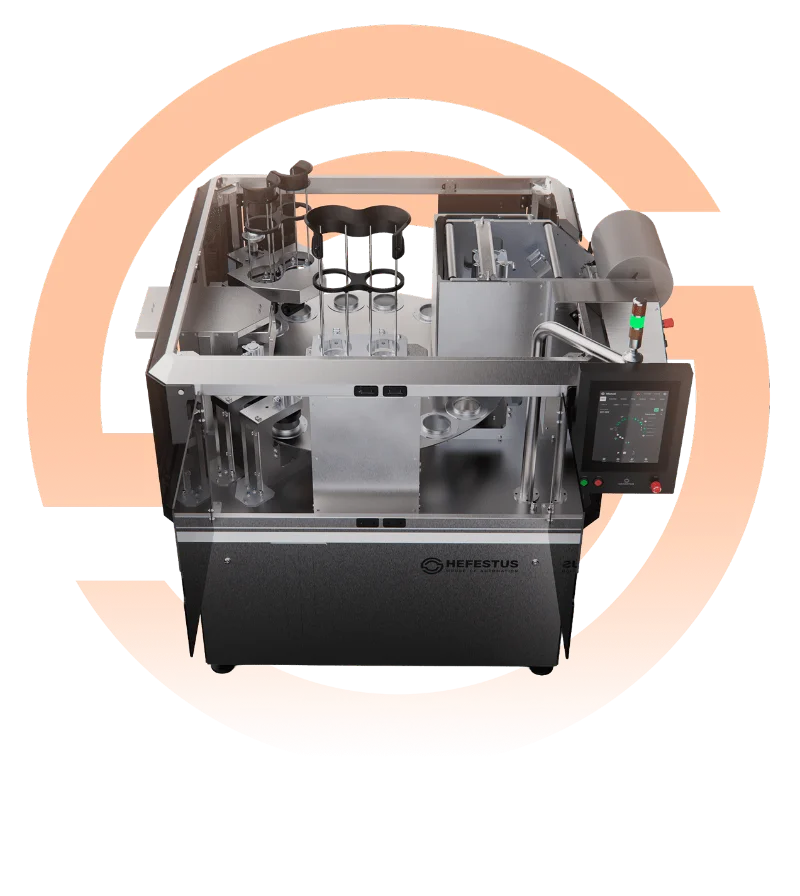
The RotoCup fills and seals pre-formed cups you buy in, indexing them past a dosing head and sealing film across the top. Cup geometry rules a machine in or out before output does, so the published envelope below matters more than the headline rate.
Ideal for: Yogurt, pudding, ice cream, coffee creamer
See it running
Specifications
Models & technical specifications
| Dimensions | L 1550 mm × W 1500 mm × H 1800–2000 mm |
|---|---|
| Weight | 650 kg (net, average) |
| Speed | 24–96 cups per minute |
| Max. cup dimensions | Single cup 146 mm; double 120 mm each; quadruple 120 mm each |
| Max. film roll diameter | 270 mm |
| Power (Europe) | 1 phase, 220V, 25A, 2000W |
| Power (USA) | 2 phase, 220V, 25A, 2000W |
Specifications as published on hefestus-tech.com.
Where this machine class fits
The RotoCup covers 1,440 to 5,760 cups an hour. Above roughly that ceiling you have outgrown pre-formed cup filling and should be looking at a form-fill-seal cup machine instead, which makes the cup from a web rather than taking one you bought. We would rather tell you that now than sell you a machine you outgrow in a year. Below it, pre-formed keeps the machine simpler and leaves you free to change cup supplier.
What to confirm for your line
- Cup diameter. Maximum single cup diameter is 146 mm; 120 mm each in a double or quadruple arrangement. Send a physical cup rather than a specification.
- Film roll diameter. Maximum 270 mm, which sets how often an operator reloads and therefore how much unattended running you get.
- Power for your country. Published as 220V, 25A, 2000W: single phase in Europe, two phase in the USA. Confirm which applies to your site.
- Fill accuracy. Ask for the tolerance and the expected giveaway at your target weight. Overfilling by one percent is an invisible cost on every cup.
- Lidding. Foil or film, printed or plain, and the reel specification as a range so more than one supplier can quote it.
Every figure above is published rather than held back for a quotation. Where the honest answer depends on seeing your product, we would rather say so than print a number that falls apart on your floor.
See it run your product
Send your pack dimensions, target output and shift pattern. You will get a written spec back — including the honest answer if this is the wrong machine for the job.
See how that works