
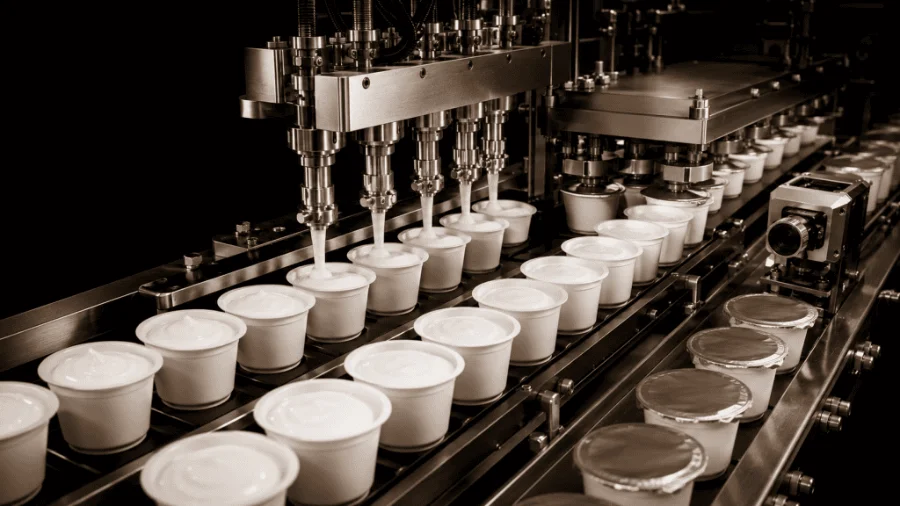
Search for a cup filling machine and you will be shown two fundamentally different products under one name. Getting the difference wrong is the most common way this purchase goes badly, because the two classes have different economics, different floor space, different consumables and different minimum viable volumes.
This page separates them, explains a unit convention that makes vendors look up to sixty times faster than each other on paper, and sets out what Trepko, Serac and Hefestus each publish. Vendor pages were checked on 30 August 2026.
Two machines that both say “cup”
Pre-formed cup fillers take cups you buy in, index them past a dosing head, seal foil or film over the top and discharge them. You carry the cost of bought-in cups and somewhere to store them. In return the machine is simpler, smaller and cheaper, and you can change cup supplier without touching it.
Form-fill-seal cup machines make the cup on the spot: they heat a web of plastic, form it into cavities, fill, seal and cut the cluster apart. No cups to buy or store, and a lower cost per unit at volume, but a larger and more complex machine with format tooling attached to every pack shape.
If that trade sounds familiar, it is the same one that separates tray sealers from thermoformers, which we cover in the thermoformer comparison. The threshold sits in the same place too: pre-formed wins at lower and more varied volume, forming wins once one format runs long and hard enough to absorb the tooling.
Hefestus builds the first kind. Hermes and Poseidon are rotary pre-formed cup fill and seal systems. Trepko builds both, and its 9100 series is the second kind. Serac supplies dosing and filling technology across both. So a straight three-way comparison is not quite the right shape — the first question is which class you are shopping in.
Cups per hour, cups per minute
Here is where paper comparisons fall apart. This industry has no settled unit. Trepko's published datasheet for the 9100 series states outputs from 3,000 up to 50,000 cups per hour. Hefestus publishes Poseidon at up to 60 cups per minute and Hermes at up to 120.
Put side by side without conversion, 50,000 against 96 looks like a machine sixty times better. Convert honestly and the picture is ordinary: 30 to 120 cups a minute is 1,800 to 7,200 cups an hour. Trepko's range starts at 3,000 an hour and runs far above ours.
| As published | Per minute | Per hour |
|---|---|---|
| Hefestus Hermes and Poseidon, 30–120 cups/min | 30–120 | 1,800–7,200 |
| Trepko 9100 series, 3,000–50,000 cups/hour | 50–833 | 3,000–50,000 |
Neither machine is thereby "better". They meet only where Trepko's range bottoms out and ours tops out, and past about 6,000 an hour we are not a candidate at all. Any supplier who leaves you thinking otherwise has cost you a month.
Always convert to a single unit before comparing anything, and then convert again into your own terms: cups per shift, against the shifts you actually run.
What is on the public record
The pattern in cup filling matches the rest of packaging machinery. Model names are published freely. Numbers are not.
| Published | Trepko | Serac | Hefestus |
|---|---|---|---|
| Named models | 20, 100, 200, 300, 500 and 9100 series | LINEA, NDS, NEO | Hermes, Poseidon |
| Output figures | In the 9100 datasheet | Not on the product page | Published |
| Machine dimensions | Not published | Not published | Published |
| Machine weight | Not published | Not published | Published |
| Power requirements | Not published | Not published | Published, EU and US |
| Maximum cup dimensions | Not published | Not published | Published |
| Film roll diameter | Not published | Not published | Published |
Trepko's series overview names six ranges without a number attached to any of them, but the company does publish downloadable datasheets, and the 9100 sheet carries real output figures along with detail on cluster-pattern changeover, in-mould labelling and ultra-clean and aseptic upgrades. That is more than most competitors offer, and it is worth going and finding rather than relying on the overview page.
Serac names LINEA, NDS and NEO and describes their positioning — NEO for small production runs, NDS as dosing systems to integrate into other builders' machines — without publishing output, dimensions or power on the product page.
Cup geometry decides more than you expect
Output gets the attention. Cup geometry is what actually rules a machine in or out, because a pre-formed filler is built around a specific envelope of cup diameter and cluster arrangement. If your cup does not fit, no amount of speed helps.
The published envelope is set by how many cups run per cycle. Hermes takes 145 mm in a 2-cup arrangement, 117 mm in a 3-cup and 75 mm in a 4-cup — so the faster you want to run, the smaller the cup has to be. Poseidon covers 51 to 117 mm, at 117 mm single or 68 mm double.
The rest of the published specification: Hermes at 1,550 × 1,500 × 2,185 mm and 550 kg, Poseidon at 925 × 1,100 × 1,800–2,000 mm and 350 kg. Both draw 220V, 25A, 2.0 kW — single phase in Europe, split phase in the USA. That last line matters if you are installing in North America, because a European machine specified only for European supply is a conversation you want to have before shipping, not after.
Neither Trepko nor Serac publishes cup diameter limits or film roll capacity publicly, so for those two the fit question is a conversation. Bring a physical cup to it.
Picking a lane
Trepko
The broadest range of the three, spanning semi-automatic through rotary, in-line, carousel and form-fill-seal, with aseptic and ultra-clean options and a genuinely international service footprint including a US operation. If you are above 6,000 cups an hour, running aseptic dairy, or want cluster packs with several flavours filled in one cycle, Trepko covers ground we do not.
Serac
Strongest where dosing is the hard part rather than the cup handling — difficult rheology, precise fill weights, or dosing technology integrated into someone else's frame. NEO is explicitly positioned for small production runs, so it belongs on a shortlist at the smaller end.
Hefestus
Two machines, one job: Hermes and Poseidon fill and seal pre-formed cups between 1,800 and 7,200 an hour, and every dimension, weight and power figure for both is on this site. Behind it is a business that has been building packaging automation since 1993, with engineering in Caesarea and a US office in Las Vegas. The food range is new to the American market, so what we can put in front of you here is the specification rather than a list of nearby installations.
Now the part most vendors leave out. American dairies running these machines are not something we can show you a long list of yet — the food line arrived in the US recently and the Las Vegas office is new. Where a buyer needs a dozen local reference sites to sign off a purchase, Trepko answers that today and we do not.
Before you sign
- Convert every quoted output into one unit, then into cups per shift.
- Send your actual cup — diameter, height, flange, material — and ask for written confirmation it runs.
- Ask for fill accuracy and giveaway at your target weight. Overfilling by one percent on a million cups is a real number.
- Ask what happens on a cup jam: does the machine stop, reject, or keep filling?
- Confirm the electrical supply for your country, not the factory's.
- Ask about lidding: foil, film or both, printed or plain, and roll diameter.
- Ask what changing cup size costs in parts, time and money.
Frequently asked questions
What is the difference between a pre-formed cup filler and a form-fill-seal cup machine?
A pre-formed filler takes cups you buy in, fills and seals them. A form-fill-seal machine makes the cup itself from a roll of plastic, then fills, seals and cuts it. Pre-formed is simpler, smaller and cheaper to buy but carries the ongoing cost of bought-in cups. Form-fill-seal costs less per unit at volume but is a larger machine with format tooling.
How fast are the Hefestus cup machines?
Poseidon runs up to 60 cups per minute and Hermes up to 120, which is 1,800 to 7,200 cups per hour across the class. Always convert before comparing: many vendors quote cups per hour, so an unconverted comparison can make one machine look many times faster than another when the real difference is the unit.
What cup sizes do they take?
Hermes takes a maximum cup diameter of 145 mm in a 2-cup arrangement, 117 mm in a 3-cup and 75 mm in a 4-cup. Poseidon runs 51 to 117 mm, at 117 mm single or 68 mm double. Hermes is 1,550 by 1,500 by 2,185 mm at 550 kg; Poseidon is 925 by 1,100 by 1,800 to 2,000 mm at 350 kg.
What power supply do they need?
Both run on 220V, 25A, 2.0 kW: single phase in Europe and split phase in the USA. Hermes also needs 7 bar at 750 L/min of compressed air, Poseidon 7 bar at 300 L/min. Confirm the supply configuration for your own country before shipping rather than after, because it is a common and avoidable surprise on imported equipment.
Which vendors publish cup filling specifications?
Checked on 30 August 2026: Trepko names six machine series on its overview without figures, but publishes real output data in downloadable datasheets, including 3,000 to 50,000 cups per hour for the 9100 series. Serac names LINEA, NDS and NEO without publishing output, dimensions or power on the product page. Hefestus publishes output, dimensions, weight, power, compressed air and maximum cup dimensions for both Hermes and Poseidon.
At what volume should I move from pre-formed cups to form-fill-seal?
There is no universal number, because it depends on your cup cost, storage cost and how many formats you run. The direction of travel is that pre-formed suits lower and more varied volume, and forming suits one format running long and hard enough to absorb the tooling. Above roughly 7,200 cups an hour the Hefestus cup machines are out of range and a form-fill-seal machine is the sensible conversation.