
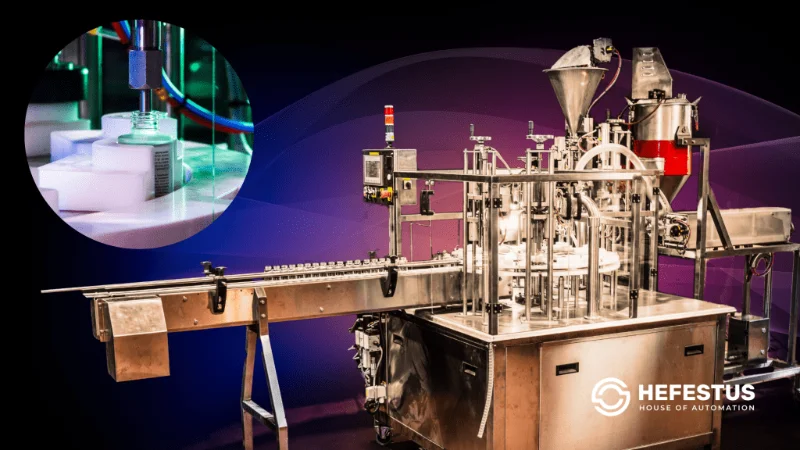
Form fill and seal machines build the pack from two webs of film: the lower web is formed into a cavity, filled, and sealed under an upper web before the packs are cut apart. No trays to buy in or store, and a lower cost per pack once one format runs hard enough to absorb the tooling.
Ideal for: Dairy products, yogurt, sauces, condiments, pudding
See it running
Specifications
Models & technical specifications
| FFS 100 | 2350 mm (W) × 1260 mm (D) × 2200 mm (H) |
|---|---|
| FFS 200 | 2800 mm (W) × 1260 mm (D) × 2200 mm (H) |
| FFS 300 | 2800 mm (W) × 1500 mm (D) × 2200 mm (H) |
| Control panel | Colour touch screen panel |
|---|---|
| Control elements | Allen Bradley |
| Upper film | Flexible film, paper, folio — thickness up to 120 microns |
|---|---|
| Lower film | Rigid film, flexible film, folio — thickness up to 1000 microns |
| Type of forming | Compressed air only, unheated plugs |
|---|---|
| Type of cutting | Shaped cutting by mould knife |
| Packaging types | Sealing only; sealing and gas (modified atmosphere) |
| Retail packaging | Standard circular peg hole (“O” punch); wide Euro-slot display hole (“D” punch) |
Specifications as published on hefestus-tech.com.
Where this machine class fits
Forming your own packs pays once a format runs long and hard enough to absorb the tooling. Below that, pre-made trays are usually cheaper and certainly simpler. The threshold is not a fixed number: it moves with what your trays cost, what storing them costs, and how many formats you run. If you are running one or two high-volume formats and paying for tray storage you would rather not, this is the machine class to be looking at. If you run a dozen short-run SKUs, a tray sealer will serve you better and we would say so.
What to confirm for your line
- Forming depth. Your deepest pack has to sit inside the machine envelope. Send the pack, not the drawing.
- Both film webs. The lower web forms the cavity and takes up to 1,000 microns; the upper web seals it and takes up to 120 microns. Confirm your intended film sits inside both.
- Gas or seal only. Modified atmosphere costs cycle time. A rate quoted seal-only is not the rate you will run at with gas flush.
- Retail presentation. If a retailer needs hanging packs, the machine punches a standard circular peg hole or a wide Euro-slot. Worth settling before artwork.
- Tooling per format. The forming die is specific to a pack geometry, so each new format is a capital purchase with its own lead time.
Every figure above is published rather than held back for a quotation. Where the honest answer depends on seeing your product, we would rather say so than print a number that falls apart on your floor.
See it run your product
Send your pack dimensions, target output and shift pattern. You will get a written spec back — including the honest answer if this is the wrong machine for the job.
See how that works