
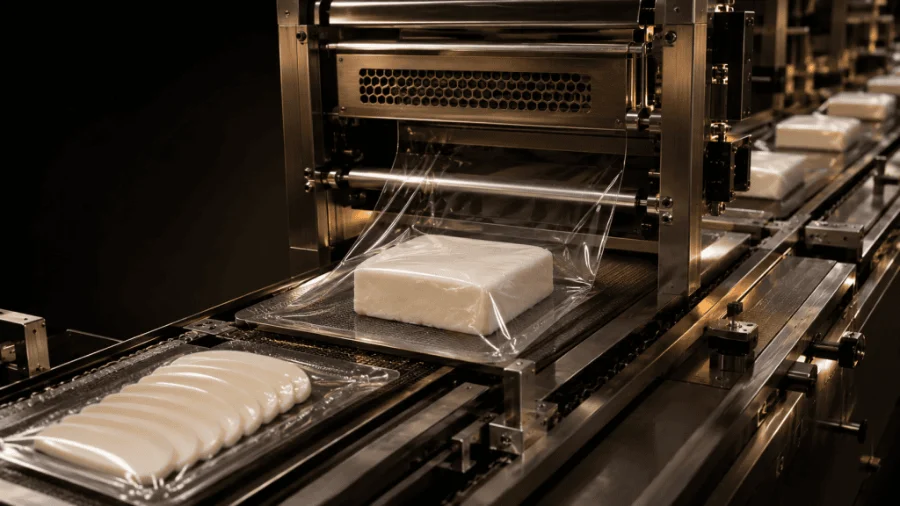
A thermoformer is a different animal from a tray sealer. Instead of buying pre-made trays and sealing lids onto them, the machine forms the pack itself out of a roll of film, fills it, seals a second film over the top and cuts the packs apart. Buy trays and you carry their cost and their storage forever. Form your own and you carry a more complicated machine instead.
That trade decides itself on volume. Below roughly a shift's worth of steady output on one format, pre-made trays usually win. Above it, rollstock film is cheaper per pack and the economics move. What this page covers is the harder part: once you have decided you want a thermoformer, how do you compare three of them when the industry barely publishes anything?
What the three actually publish
We checked the public product pages of MULTIVAC, SEALPAC and Hefestus on 30 August 2026. The result is not close, and it is not flattering to the industry.
| Published on public product pages | MULTIVAC | SEALPAC | Hefestus |
|---|---|---|---|
| Model names | Many (R 085, R 105, R 126, R 145, D 200, RX 4 and others) | RE20, RE25, F4, F5, F6 | FFS 100, FFS 200, FFS 300 |
| Machine dimensions | Not published | Not published | Published for all three |
| Film thickness limits | Not published | Not published | Published, upper and lower web |
| Film width | Not published | Published for F6 | Not published |
| Control system | Not published | Not published | Published |
| Forming method | Not published | Not published | Published |
| Cutting method | Not published | Not published | Published |
| Electrical load | Not published | Not published | Not published for FFS |
MULTIVAC names a great many machines across its compact and high-output series and gives each a paragraph of description, but its public pages carry no forming depth, no film width, no output rate, no power figure and no dimensions. SEALPAC is slightly more open: the F6 page states that the line processes film widths from 560 to 660 mm, which is a real, usable number.
We should be even-handed about our own gaps. Hefestus does not publish an electrical load for the FFS range, though we do publish it for the tray sealers and the cup filler. If you are quoting the install, ask us for it — the same way you should ask anyone else.
Cycles are not packs
This is the single most expensive misunderstanding in thermoformer buying, and it catches experienced people.
A tray sealer quotes packs per minute, and a pack is a pack. A thermoformer quotes cycles per minute, and one cycle produces however many packs fit across the width and length of the forming die. A machine running 12 cycles a minute with a die laid out four across and two down is producing 96 packs a minute. The same machine, running one large cavity for a family-size tray, is producing 12.
So a cycle rate on its own tells you almost nothing about output. What you need is the cycle rate and the cavity layout for your specific pack size, and those two together give you packs per minute. When a vendor quotes cycles, the follow-up question is always: at what layout, for a pack of my dimensions?
The Hefestus FFS range is quoted at 100 to 300 units per minute. That is stated in finished units rather than cycles precisely to avoid this trap, but the same scrutiny applies: pin it to your pack size before you rely on it.
Film is the constraint nobody leads with
Speed sells machines. Film decides whether the machine can make your pack at all, and it governs your running cost for the life of the line.
A thermoformer draws from two webs. The lower web is formed into the cavity and must be rigid enough to hold shape; the upper web is sealed over the top and is usually flexible. The thickness each machine can handle sets the boundary of what packaging you can design, and it is worth knowing before you commission artwork.
The published Hefestus FFS film envelope is a lower web of rigid film, flexible film or folio up to 1,000 microns, and an upper web of flexible film, paper or folio up to 120 microns, with printed upper film supported. Forming is by compressed air alone with unheated plugs. Cutting is shaped, by mould knife. The machine seals alone or seals with gas flush for modified atmosphere, and it can punch a standard circular peg hole or a wide Euro-slot for retail display hanging.
That last detail sounds trivial until a retailer requires hanging packs and your machine cannot punch them. Neither MULTIVAC nor SEALPAC publishes its film envelope or its punch options publicly, so for those two the answer arrives in a quotation rather than a specification page.
Paper upper webs matter increasingly too. If a customer or a regulator pushes you toward reduced-plastic packaging, the question of whether your machine will run a paper-based web stops being theoretical. It is worth asking all three.
Choosing between them
MULTIVAC
The broadest portfolio in the category by a wide margin, spanning entry-level compact machines to high-output and medical-grade lines, with a global service organisation behind it. If you need a machine class that does not exist elsewhere, or you are standardising a multi-site operation on one vendor, that breadth is the argument and it is a strong one. You will do your comparing in meetings rather than on the website.
SEALPAC
A focused German builder with a clear thermoformer and traysealer range and a reputation built on pack presentation and format flexibility. The F-series is positioned around short changeover times, which matters a great deal if you run many SKUs on one line. It publishes a little more than MULTIVAC and rather less than we do.
Hefestus
Hefestus Technologies has built packaging automation since 1993 and runs a US office in Las Vegas. Three FFS models cover 100 to 300 units per minute, with dimensions and the full film envelope published for each. What we cannot yet show you is an American food reference site, which is why this page argues from specifications rather than from installations.
The same caveat we put on every page of this kind: our food line is new in the United States. We run a US office in Las Vegas, but we cannot yet hand you a long list of American food manufacturers running our thermoformers. If a deep domestic reference list is what settles the decision for you, the German brands will win that comparison today and we would rather say so than pretend otherwise.
What to put in your RFQ
Send the same document to all three. Differences in what comes back are more informative than anything on a website.
- Cycle rate and cavity layout for my pack dimensions, giving packs per minute.
- Maximum forming depth, and whether my deepest pack is near that limit.
- Upper and lower web thickness range, and whether paper-based upper web is supported.
- Film width range, and the cut-off length range.
- Electrical load, compressed air demand and cooling water requirement.
- Changeover time between my formats, and the cost of each additional tool.
- Lead time from order to commissioned, and who performs commissioning.
- Nearest service engineer and the contractual response time on a stopped line.
The tooling question in particular deserves more attention than it usually gets. A thermoformer's forming die is specific to a pack geometry, so every new format is a capital purchase, not a settings change. Ask what a second tool costs before you sign for the first machine, because a cheap machine with expensive tooling can be the dearer line over five years.
Frequently asked questions
What is the difference between a thermoformer and a tray sealer?
A tray sealer seals a lidding film onto pre-made trays you buy in. A thermoformer forms the pack itself from a roll of film, fills it, seals a top web over it and cuts the packs apart. Thermoformers remove the cost and storage of bought-in trays, at the price of a more complex machine and format-specific tooling.
How many packs per minute does a thermoformer produce?
It depends on the cavity layout, not just the cycle rate. One cycle produces as many packs as fit across the forming die, so 12 cycles a minute could be 12 packs or 96. Always ask for the cycle rate together with the cavity layout for your pack dimensions.
Why do so few thermoformer makers publish specifications?
The machines are configured to order, so vendors prefer to establish requirements in conversation. Checked on 30 August 2026, MULTIVAC's public pages name many models without forming depth, film width, output rate, power or dimensions. SEALPAC publishes a film width range for the F6. Hefestus publishes dimensions and the full film envelope for FFS 100, 200 and 300, but not electrical load.
What film thickness can the Hefestus FFS range handle?
The lower web takes rigid film, flexible film or folio up to 1,000 microns. The upper web takes flexible film, paper or folio up to 120 microns, and printed upper film is supported. Forming is by compressed air alone with unheated plugs, and cutting is shaped by mould knife.
Can a thermoformer run paper-based packaging?
Some can on the upper web. The Hefestus FFS range lists paper as a supported upper web material. If reduced-plastic packaging is on your roadmap, ask every vendor to confirm it in writing rather than assuming, because it is rarely on a public specification page.
How much does tooling cost on top of the machine?
Each pack geometry needs its own forming die, so a new format is a capital purchase rather than a settings change. Ask what a second tool costs before signing for the first machine. A cheaper machine with expensive tooling can be the more expensive line across five years.