
Sauces and dressings are the category where a single line is most often asked to do too much. A thin vinaigrette and a thick barbecue sauce are different filling problems, and most condiment producers run both. The specification question is not "how fast" but "across what range".
Establish Your Viscosity Range First
Before anything else, list every SKU you will run in the next two years with its viscosity and whether it carries particulates – herbs, seeds, pepper flakes, vegetable pieces. The spread between your thinnest and thickest product is the number that decides whether one machine can serve the range or whether you are looking at two.
A filling system quoted against a nominal viscosity will not necessarily hold accuracy at both ends of a wide range. Ask for the accuracy figure at your thinnest product and your thickest, not at a convenient midpoint.
Oil Separation Is a Filling Problem, Not a Recipe Problem
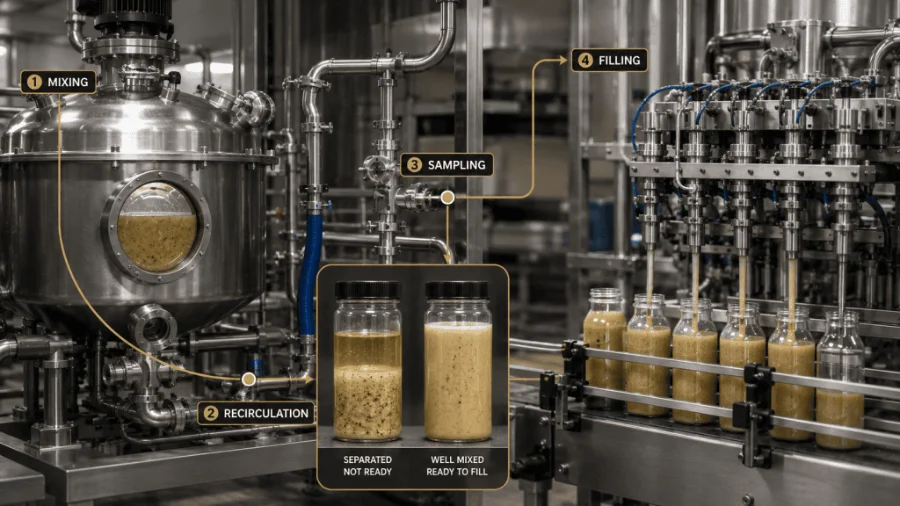
Emulsions separate, exactly as they do in hummus. When they separate in the hopper mid-run, fill accuracy drifts and product uniformity suffers – the customer opening the last jar off the run gets something different from the first. This is one of the recurring reasons sauce lines underperform their spec sheet.
Ask how the machine keeps product homogeneous through a run: agitation, recirculation, hopper geometry, or a combination. Then ask for fill accuracy measured at the end of a full run rather than the start.
Leak Risk Has Gone Up
Sauce and dressing packaging that was adequate for a retail pallet is not automatically adequate for a parcel network. E-commerce channels expose seals to handling that shelf distribution never did, and a leaking bottle in a mixed carton damages more than one product.
If any part of your volume ships direct to consumers, make seal integrity an explicit specification with a defined test, rather than assuming retail-grade sealing carries over.
Format Decides the Machine
Settle the container before shortlisting equipment. Bottles, jars, cups, pouches and sachets are different filling and closing problems, and a line built for one does not absorb another as a changeover part. If squeeze bottles and single-serve sachets are both on the roadmap, say so during specification.
Throughput Tiers
Sauce lines are commonly configured in tiers, and matching the tier to your genuine volume matters more than buying headroom you will not use:
- An entry-level configuration for smaller producers runs up to 100 units per minute.
- A mid-capacity tier reaches up to 200 units per minute, with support for multiple packaging formats.
- A high-output industrial configuration handles large-scale retail or foodservice volume.
Work out which tier you need from units per day divided by realistic shift hours, with changeover and cleaning subtracted. Our form fill and seal systems run 100-300 units per minute; cup fill and seal covers 30-120 cups per minute where the format calls for it.
Cleaning Between Flavours
Condiment producers change flavours often, and colour and allergen carryover both matter. A tomato-based sauce followed by a pale dressing is a visible failure if cleaning is inadequate. Ask what a flavour changeover involves, how much of it is tool-free, and whether allergen changes need a different procedure again.
Multiply the honest changeover figure by your weekly changes. That total is capacity you do not have, and it is frequently the deciding difference between two machines with identical headline speeds.
Questions That Reveal the Difference
- What fill accuracy do you hold at my thinnest and thickest product?
- How is the product kept homogeneous through a full run?
- What is your seal specification for parcel shipping, and how is it tested?
- What does a flavour changeover involve, and an allergen changeover?
- Can I see it run my actual product, at both ends of my viscosity range?
Particulates Change the Machine
Herbs, seeds, pepper flakes, vegetable pieces and cheese fragments all turn a straightforward filling job into a dosing problem. Standard nozzles sized for smooth product either block or dose inconsistently once solids are in the stream, and accuracy figures measured on smooth product do not carry over.
Three numbers determine what you need: the largest particle you will run, the proportion of solids to liquid, and whether particulates are distributed evenly or need to be dosed separately. A chunky salsa and a smooth ketchup can share a line, but only if it was specified for both.
Ask specifically whether solids settle in the hopper during a run. Suspension behaviour changes as product level drops, and a machine that doses accurately from a full hopper may drift as it empties.
Hot Fill Changes the Specification
Many sauces are filled hot for shelf stability, and that decision propagates through the entire line. Containers must tolerate the fill temperature without deforming. Seal parameters differ from cold-fill equivalents. Cooling has to be handled before packing, or heat softens containers under stacking load.
If you hot fill, or expect to, establish it before comparing machines. Retro-fitting hot-fill capability to a line specified for ambient is usually more expensive than specifying it correctly at the outset, and sometimes not possible.
Colour and Allergen Carryover
Condiment producers change flavour frequently, and two kinds of carryover matter. Colour carryover is visible: a tomato-based product followed by a pale dressing shows any inadequacy in cleaning immediately, and it is a customer complaint rather than an internal issue.
Allergen carryover is invisible and far more serious. Mustard, egg, dairy, soy, sesame and nuts appear across sauce and dressing ranges, and an allergen change requires validated cleaning rather than a rinse. Ask what a validated allergen changeover involves on each machine, how long it takes, and what documentation the system produces to evidence it.
If you run allergen and non-allergen products on shared equipment, the cleaning procedure is not an operational detail to resolve after purchase. It is a specification that should shape which machine you buy.
Viscosity Is Not Constant
One further complication worth raising during specification: many sauces change viscosity with temperature and with shear. Product that flows readily after mixing may thicken as it stands. Product pumped through a long line arrives at the filler with different characteristics than it left the kettle with.
This is why accuracy figures should be measured at the filler, at your process temperature, after your actual pumping route – not on a bench sample. It is a reasonable thing to insist on, and a vendor who is comfortable with the request is telling you something useful.