
A cheese line is usually several lines wearing one name. Equipment that vacuum-packs a bulk block has almost nothing in common with a machine dosing shred into a resealable pouch, and a slice-and-tray operation is different again. Before any supplier can quote something useful, you have to decide which of those you are buying now – and admit which of the others you will want within three years.
What follows is a specification checklist, not a category overview. Category sizing and regional demand are covered separately in our market write-up; this piece is about the decisions that end up written into a purchase order.
Decide Which Cheese You Are Packing
Cheese stays biologically active inside the pack. It loses moisture, releases liquid, and in rind-ripened varieties has to keep exchanging gas with the outside or ammonia builds up. That behaviour, rather than the brand on the label, is what selects equipment.
| Cheese form | Format that usually wins | What the equipment has to cope with |
|---|---|---|
| Blocks and loaves | Vacuum shrink bag or vacuum skin | Drawing air off an irregular, waxy surface without folding |
| Sliced and stacked | Thermoformed tray with lidding film | Stack alignment and a clean flange on every cycle |
| Shredded | Resealable stand-up pouch | A free-flowing product that bridges, plus oxygen exclusion |
| Fresh, held in liquid | High-barrier tubs and cups | Purge and brine that must never reach the sealing surface |
| Spreadable and cream | Rigid tub, peelable lid | Viscous dosing and a lid that lifts without tearing |
| Snack portions | Flow wrap | Uniform items at pace, with tight print registration |
Most producers occupy at least three of those rows. The useful question is never whether one machine covers all of them – it does not – but which two you automate first, and what you leave physical and electrical room for.
Barrier Belongs in the Brief as a Number
More than 61% of natural cheeses need specialised barrier films to hold off mould growth and oxidative rancidity, so oxygen transmission is a shelf-life specification rather than a purchasing preference. Write down the shelf life the retailer expects, then work backwards to the transmission rate the structure has to hold – and check that the machine can seal that structure reliably, not merely accept it.
This matters more than usual right now because the film is going to change under you. Recyclable mono-PE reaches only 30 to 40% of the oxygen barrier of the multilayer laminates it is replacing, and the EU’s packaging regulation requires packaging to be designed for recyclability by 2030. A sealer bought this year will very likely be running a different film structure before it is paid off.
So ask about the seal window rather than a single seal temperature. How wide is the usable range of temperature, pressure and dwell? What happens to that window when the sealant layer changes? A machine with a narrow window will pass a demonstration and then produce leakers the first time a supplier reformulates.
Shred and Grated Are the SKUs That Break Lines
Shredded cheese behaves like a difficult powder rather than like cheese. It bridges in hoppers, it aerates, it carries an anti-caking agent through every contact surface, and fines from it end up exactly where you least want them: on the sealing area of the pouch. Oxygen exclusion is the other half of the problem, which means a gas flush and enough headspace to displace air trapped between the strands.
Three things to establish with a vendor before shred goes anywhere near a quotation: how the dosing system handles a low-density product without giving away weight, what the anti-caking agent does to contact-part wear over a year of running, and how the seal area is kept clear of strands at speed. The last one is the usual root cause of pouch leakers.
Fresh Varieties Put Liquid Where the Seal Goes
Mozzarella, ricotta and similar fresh cheeses purge liquid, and many of them are packed in brine by design. Any moisture that reaches a flange or a lidding surface compromises the seal, and a chilled hall adds condensation on top of that. Filling nozzles that cut off cleanly, drip management between fill and seal, and a positive way of clearing the flange are not refinements here; they are the difference between a saleable pack and a returned pallet.
Ask what the machine does when a container arrives with liquid already on the rim, because on a fresh line it will.
Portion Tolerance Is Where the Money Is
Automated slicing and portioning holds tolerances in the range of one to two grams, with inline checkweighing behind it and robotic pick-and-place moving portions into packs. That precision is not about tidiness. Every gram handed over the declared weight is product you made and did not sell, multiplied by every pack you ship.
Work out what a one-gram improvement is worth annually across your volume before you compare quotes. On a mid-sized operation it frequently justifies the difference between two machines on its own, and it is a number your own production data can answer without any vendor involvement.
Specify Residual Oxygen, Not the Gas Mix
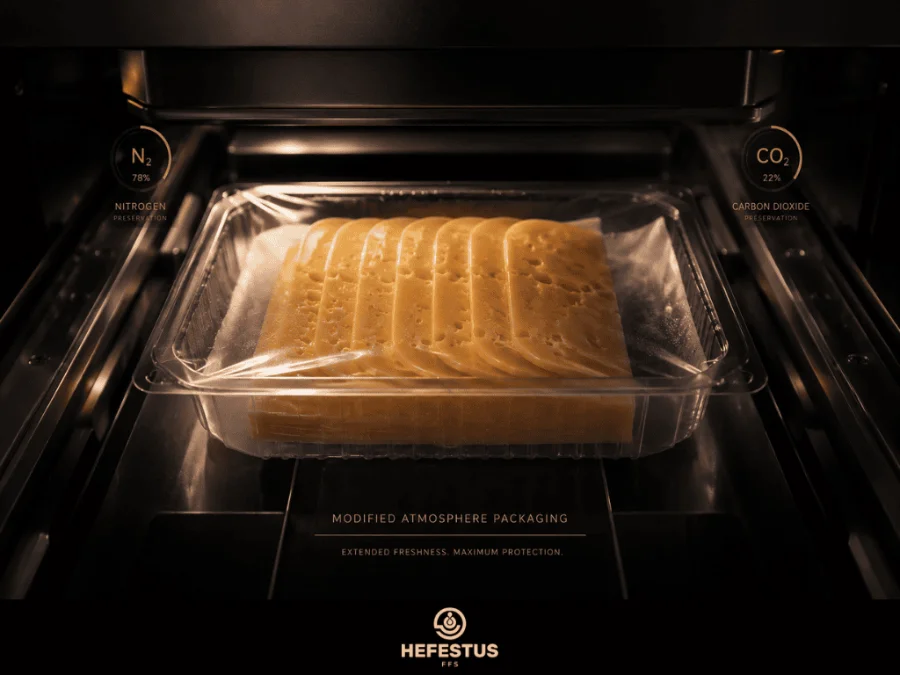
Gas flushing for cheese uses a carbon dioxide and nitrogen blend tuned to the variety, and the right blend for a hard cheese is not the right blend for a soft one. But the gas ratio at the manifold is the supplier’s variable, not your specification.
What you should be specifying is the oxygen level remaining inside the pack after sealing, how often it is verified, and what the line does with a pack that misses it. A vendor who can quote that figure at your rated speed – not at demonstration pace – is telling you something real about the machine.
Hygiene Here Is a Listeria Question
Dairy sanitation requirements shape how the machine is built, not just how it is documented. Stainless construction, IP65-rated electrical protection for washdown, clean-in-place compatible surfaces and an absence of crevices where residue can sit are the baseline for cheese environments. Certification – FDA and USDA compliance, ISO 9001, CE – confirms the framework, and then you still have to ask the operational questions.
How long is a full strip-down? Which parts come off by hand and which need a technician with tools? Is the changeover between a mould-sensitive fresh SKU and a hard cheese a rinse or a complete teardown? Every hour of that is capacity you are buying and not using.
Matching Systems to Formats
Once the formats are settled, capacity becomes arithmetic. Take the packs you have to ship in a week, divide by the hours the line will genuinely be available after cleaning and changeovers, and compare that figure against the systems rather than comparing the systems against each other.
| System | Rated throughput | Cheese formats it suits |
|---|---|---|
| Cup Fill & Seal | 24-96 cups/min | Fresh cheese in tubs, cream cheese and dips |
| Form Fill & Seal | 100-300 units/min | Shred pouches and portion packs formed in line |
| Tray Sealers | 40-180 trays/min | Sliced and portioned cheese under a lidding film |
For continuous thermoforming, where trays are formed from rollstock, gas-flushed, filled and sealed in one pass, cycle rates of 40 to 120 per minute are typical – but a cycle carries several packs, so compare packs per hour rather than cycles per minute when two suppliers quote differently.
Where the Labour Actually Comes Out
Across the 500-plus systems we have deployed, packaging labour falls by 40 to 80% and the investment returns inside 8 to 14 months. On cheese, those savings are not spread evenly – they concentrate in four places:
- Portioning and weighing – consistent cut weight, which cuts giveaway as well as headcount.
- Loading – pick-and-place into trays or pouches, the most repetitive job on a cheese line and the one hardest to staff.
- Gas flush and seal – a repeatable atmosphere and closure instead of an operator-dependent one.
- Inspection and end of line – checkweighing, seal verification and case packing before anything reaches a pallet.
Consistency usually carries the business case further than headcount does. A retailer rejecting a delivery over seal defects costs more in a single incident than the labour difference over a quarter.
Put These to the Supplier
- How wide is the seal window on my film, and what happens to it if the structure changes?
- What residual oxygen do you hold at my rated speed, and how is it measured?
- Show me shred running – what keeps strands out of the seal area?
- What is the fill-weight tolerance over a full shift, not a sample run?
- What does a complete teardown and sanitation cycle take, in hours and in people?
- Which tooling changes when I add a tray footprint, and what does that tooling cost?
The tooling question is the one most often skipped, and it is the one that stings later. Every new tray size on a thermoformer or tray sealer is a tooling purchase and a changeover, and a plan for six SKUs quietly becomes a plan for six sets of tooling.
The Shortlist
Pick the two formats that carry your volume and specify hard against those, rather than buying something adequate at everything. Put oxygen transmission and residual oxygen in the brief as measured numbers. Assume the film will change and buy a wide seal window. Price your giveaway before you compare machines, because portion tolerance is where the return actually sits. And insist on seeing your own product run – shred especially – at the speed you intend to operate.
Working out a cheese line?
Tell us your formats, shelf-life targets and weekly volume, and we’ll tell you what the line has to do.
Get in Touch