
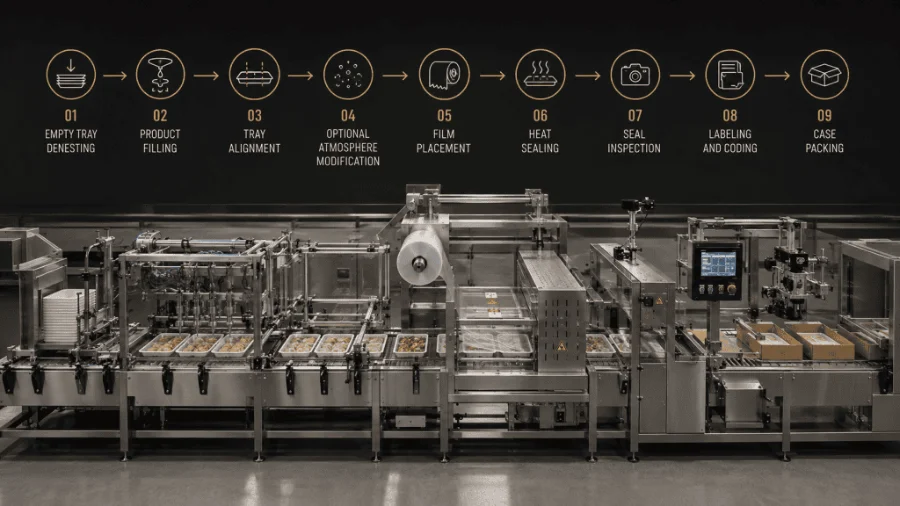
Tray sealing covers a wide span of products – ready meals, fresh proteins, bakery, deli, prepared salads – and the equipment decision usually comes down to two questions: how many tray formats you need to run, and whether the volume justifies full automation.
Count Your Tray Formats Honestly
Every tray size, depth and material you run is a tooling set and a changeover. Producers frequently underestimate this at specification time and discover the cost later, when a line that runs one format beautifully spends a third of its week being reconfigured.
List every format you run now and every one you expect within two years. Then ask each vendor what changing between them involves: tooling cost per format, changeover duration, and how much can be done without a technician.
Automated or Semi-Automatic
The two options solve genuinely different problems rather than sitting on a simple price ladder:
| Fully automated | Semi-automatic | |
|---|---|---|
| Best for | High-volume continuous production | Frequent format changes, varied handling |
| Manual handling | None through the sealing stage | Operator loading between stages |
| Capital cost | Higher | Lower |
| Flexibility | Optimised for consistency | Easier to reconfigure |
Fully automated lines offer maximum throughput with no manual handling, which suits large-scale production. Semi-automatic systems offer greater flexibility at lower capital cost, which suits producers whose format mix changes frequently or whose volumes are still growing.
The honest test is your format-change frequency. High volume on few formats favours automation; moderate volume across many formats often does not.
Film and Seal Specification
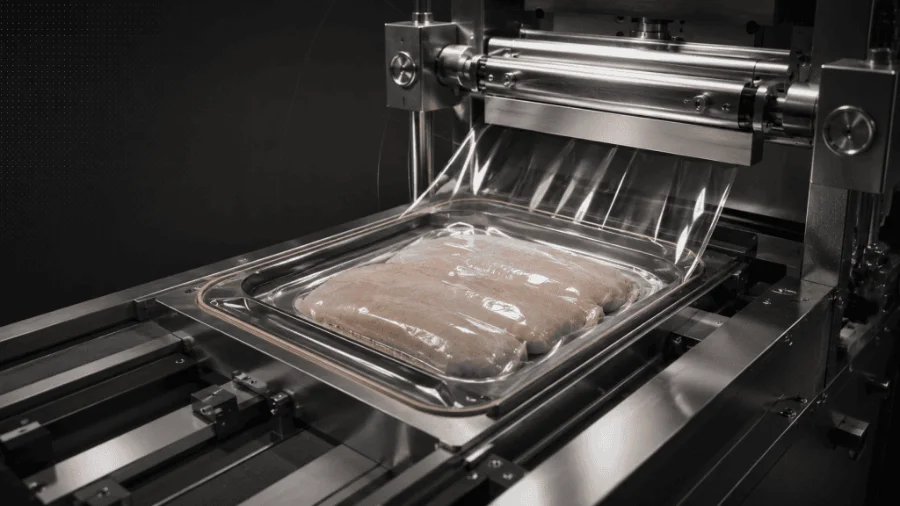
Seal integrity is the whole point of a tray line. Specify it against your actual shelf-life target and distribution route, and be clear about which sealing approach you need – standard lidding, modified atmosphere, or vacuum skin for fresh proteins where presentation and shelf life both matter.
Sustainability requirements have complicated this. Mono-material and recyclable film structures do not always behave identically to the conventional laminates a line was commissioned on, and a material change can require re-qualification. If a film switch is planned, raise it during specification rather than after.
Sizing the Line
Tray sealing throughput depends on tray size, product, sealing format and machine configuration. Work out where you sit by taking daily tray volume, dividing by realistic running hours, and subtracting format changeovers and cleaning.
Where the pack is formed in line rather than pre-made, form fill and seal at 100-300 units per minute may be the better architecture. That is worth settling before comparing tray sealers against each other.
On the return side, the figure that matters is the one built from your own operator count, shift pattern and reject rate. For trayed products the quality argument is often stronger than the labour one: a consistent seal on every pack is what stops returns from a retailer.
Worth Asking
- What is the tooling cost per tray format, and the changeover time between them?
- What seal integrity do you hold across my full shelf life, not at day one?
- If I move to a mono-material film, what has to be re-qualified?
- How does the line detect a failed seal inline?
- Can I see it run my trays, with my film, at my speed?
Modified Atmosphere Adds Requirements
If your product needs modified atmosphere packaging, that decision shapes the machine rather than sitting alongside it. MAP requires gas flushing capability, tighter seal integrity, and typically inline verification that the atmosphere in each pack is correct.
The specification questions are concrete: what residual oxygen level do you need, how consistently is it achieved across a full run, and how does the line verify it? Residual oxygen that drifts through a run gives you packs at the end that will not make their shelf-life claim, and the failure appears at the retailer rather than on your line.
Vacuum skin packaging is a different proposition again, used where presentation and shelf life both matter for fresh proteins. It holds product firmly against the film, which improves appearance and extends life, but it demands different tooling and film. Decide which of the three you need – standard lidding, MAP, or vacuum skin – before comparing machines, because few do all three equally well.
Tooling Cost Is the Hidden Number
Tray sealing quotes usually present machine price prominently and tooling cost quietly. For a producer running several tray formats, tooling can represent a substantial fraction of total cost, and it scales with every format you add.
Ask for tooling cost per format explicitly, and ask what happens when you introduce a new tray size in two years. Some systems require a full tool set per format; others accommodate a range within one set. That difference does not appear in a headline price comparison but it determines what the line costs you over its life.
The related question is changeover time between tooling sets. A ten-minute tool change and a ninety-minute one lead to completely different production planning, and the difference compounds every week.
Seal Integrity Across Shelf Life
A seal that passes inspection at end of line has not yet proven anything. What matters is seal performance at the end of the claimed shelf life, after the product has been through distribution, temperature variation and handling.
Specify against that, not against day one. Ask what testing the vendor does, over what period, and under what conditions. Ask how the line detects a marginal seal inline – a seal that is weak rather than absent is the one that reaches a customer.
For trayed products specifically, film-to-tray compatibility matters as much as machine capability. A seal is only as good as the match between the film, the tray flange material and the sealing parameters, which is why a film change is never purely a procurement decision.
Line Balance Around the Sealer
Tray sealers rarely operate in isolation. Product loading, denesting, weighing, lidding and end-of-line packing all have to keep pace, and the sealer's rated speed is only achievable if everything around it does.
When comparing machines, ask what the realistic sustained rate is within a complete line rather than the peak rate of the sealer alone. The gap between those two numbers is often where a disappointing installation originates.