
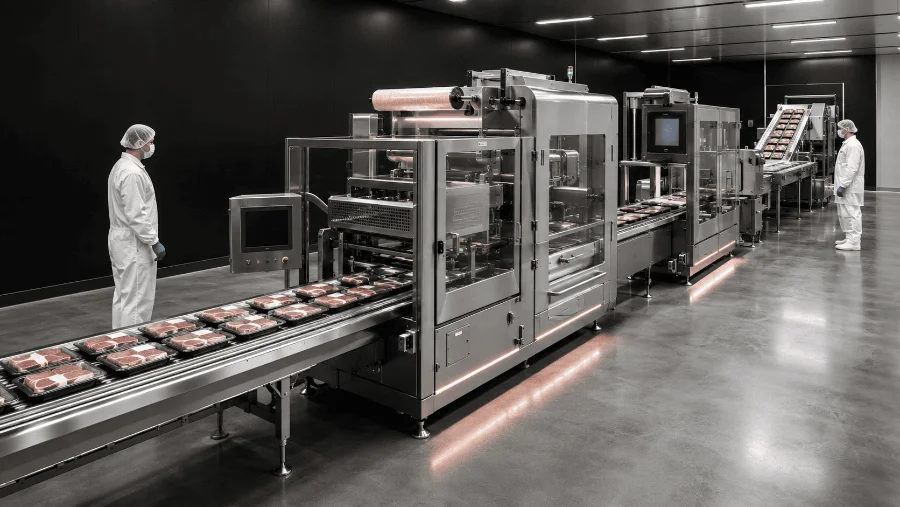
Ask a supplier what their machine runs at and you will get a number. Ask what it does with purge on a warm summer afternoon when the trays are coming through slightly overfilled, and you will learn considerably more. Meat is wet, uneven, variable in weight and unforgiving of a marginal seal, and the specifications that actually decide between two quotes are rarely the ones printed on the brochure.
This guide is for processors writing a brief. Sector sizing and equipment demand forecasts are covered separately in our market article; here we stay on the engineering.
Purge Is the Constraint Everything Else Works Around
Liquid released by the meat after packing determines more of your line design than any other single factor. It pools in the tray, it wicks up onto the flange, it reaches the sealing surface, and it shows through the film in a way shoppers read as age. It also moves weight around: a pack that leaves the checkweigher correct can look different by the time it reaches the shelf.
The practical decisions that follow are tray depth and cavity design, whether an absorbent pad is placed and how reliably the placer works, and what the machine does to clear the flange in the instant before the tool closes. Get a supplier to talk through that sequence in detail. If they treat purge as something you manage with pad selection alone, they are not thinking about the line.
Fat is the second contaminant on the same surface, and it behaves differently – it smears rather than pools, and it degrades a seal without being obvious in inspection. Ask how often the sealing tool needs cleaning during a shift on fatty product, because that answer is downtime.
Choose the Pack Architecture Before the Machine
Four architectures cover almost all retail meat, and they are genuinely different capital purchases rather than options on one platform.
| Architecture | What it suits | What it costs you |
|---|---|---|
| Pre-formed tray plus sealed lidding film | Mixed SKUs, frequent format changes | Tray purchase price and tray storage space |
| Thermoformed web, formed in line | High, steady volume on few formats | Tooling per format and longer changeovers |
| Vacuum skin | Premium cuts, presentation-led lines | Slower cycles, higher film cost per pack |
| Vacuum bag or shrink | Primals, export and long chilled transit | Little retail shelf appeal without overwrap |
| Flow wrap | Uniform processed items such as sausage and deli | Struggles with irregular fresh cuts |
The rule that catches people out is uniformity. Horizontal wrapping works beautifully on consistent, pre-portioned product and badly on irregular fresh cuts, which is why processed and fresh operations tend to end up with different equipment even inside the same building.
Tooling Is the Number Nobody Quotes
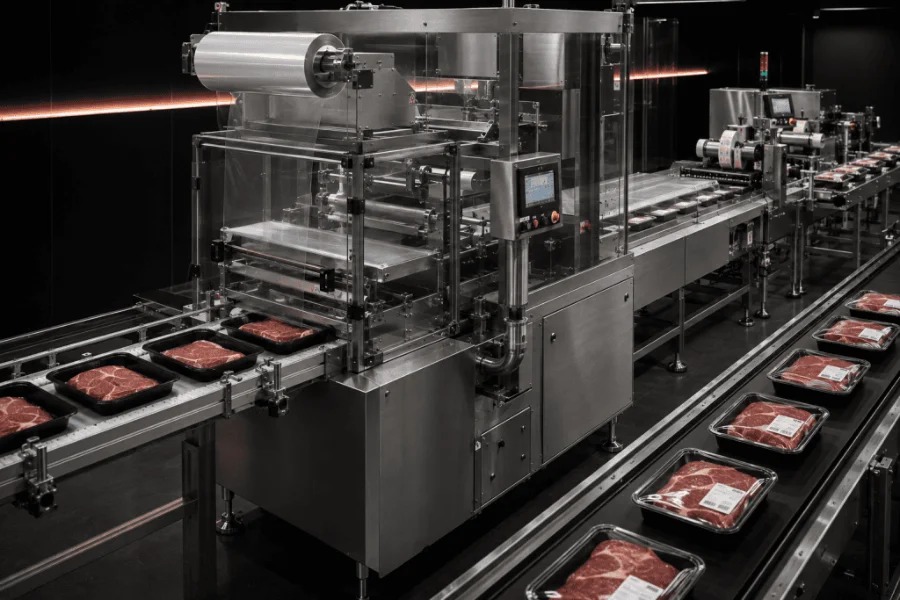
Every distinct tray footprint on a sealer or thermoformer needs its own tooling, and each additional set is both a purchase and a changeover. A plan for eight SKUs becomes a plan for however many tray sizes those SKUs use, which is usually a smaller number than eight and always a bigger number than one.
Before you compare machines, consolidate your tray footprints on paper. Two sizes covering nine products is a much cheaper line than five sizes covering the same nine, and that consolidation is entirely within your control. Then ask each supplier for the tooling price and the changeover time per set, and add both into the comparison.
Gas Mix Is a Product Decision, Residual Oxygen Is a Spec
Gas flushing serves two different purposes on a meat line, and confusing them causes trouble. Red meat needs oxygen present to hold the bright colour shoppers associate with freshness, balanced against carbon dioxide to suppress spoilage organisms. Poultry, cooked and cured products generally want oxygen out entirely, with carbon dioxide and nitrogen doing the work.
That means a line running beef trays and cooked deli through the same sealer needs two gas recipes and a controlled way of switching between them. Ask how recipes are stored, how the changeover is verified, and what prevents a pack being sealed under the wrong atmosphere.
What belongs in your specification is the oxygen level inside the finished pack, the frequency at which it is checked, and the rejection route for packs that miss. Gas ratio at the mixer is how the supplier gets there; residual oxygen in the pack is what you are buying.
Catchweight Changes the End of the Line
Most fresh meat is sold by variable weight, which makes weighing a functional part of packaging rather than a check on it. Each pack has to be weighed, priced from that weight, and labelled with the result, in sequence and without packs and labels getting out of step. If a pack is rejected mid-sequence, the label stream has to follow it.
This is worth specifying explicitly because it is where retrofitted lines most often fail. Ask how weight data reaches the labeller, what happens on a reject, and how the line recovers after a stop without mislabelling the packs already in the machine.
Detect the Bad Pack Before It Leaves
A leaking pack found by a retailer costs many multiples of one found on your own line. Modern lines embed that detection rather than sampling for it afterwards: vision systems catch seal defects, foreign material and mislabelling; seal verification confirms pack integrity before dispatch; and sensor data flags mechanical drift early enough to schedule the repair rather than suffer the breakdown.
The specification question is coverage, not capability. Is every pack checked or a sample? What triggers a reject, where does the rejected pack physically go, and does anybody have to touch it? A rejection system that requires an operator to intervene has just reintroduced the labour you were removing.
Sanitation Sets the Machine, Not the Paperwork
Meat halls are washed hard and often. Equipment has to be built with no crevices where residue or bacteria can settle, in corrosion-resistant material that survives repeated high-pressure cleaning, with tool-free access to the parts that need attention between runs. FDA and USDA compliance, ISO 9001 and CE certification frame the requirement; the machine design determines whether you meet it in practice.
Time the sanitation cycle during the visit. The gap between a machine that strips in twenty minutes and one that takes an hour compounds every single day of the equipment’s working life, and it rarely appears anywhere in the quotation.
Working Out the Capacity You Need
Convert your requirement into packs per available hour before you look at any rated speed. Weekly volume, divided by the hours the line will run after sanitation and changeover time has been subtracted, is the figure to hold suppliers against.
| System | Rated throughput | Typical meat application |
|---|---|---|
| Tray Sealers | 40-180 trays/min | Retail trays of fresh cuts, mince, poultry and deli |
| Form Fill & Seal | 100-300 units/min | High-volume formats formed from film in line |
| Cup Fill & Seal | 24-96 cups/min | Prepared meat products, pates and portioned foodservice packs |
Buy headroom deliberately rather than generously. Capacity you never use is capital sitting on the floor, but a line at its ceiling on day one leaves you with no route to absorb a new listing except another purchase.
What the Automation Is Actually Worth
Recruiting for repetitive work in a chilled meat hall has become structurally hard, which shifts the arithmetic. On the systems we have installed – more than 500 of them – packaging labour drops by 40 to 80%, uptime runs at 99%, and the investment typically returns in 8 to 14 months. On a meat line the return concentrates here:
- Loading and placement – product positioned consistently in the cavity, which is what keeps the flange clean.
- Atmosphere and closure – the same gas condition and the same seal on every pack, every hour of the shift.
- Weighing and labelling – catchweight pricing handled inline instead of as a separate manual station.
- Verification – every pack inspected before it joins a pallet, rather than a sample after the fact.
Six Questions That Separate Two Quotes
- Walk me through what happens to purge between filling and sealing.
- How many tray footprints does my SKU list actually need, and what does each set of tooling cost?
- How are gas recipes stored and verified when I switch from beef to cooked product?
- Is every pack seal-verified, or a sample – and where does a reject physically go?
- How does weight data reach the label, and what happens to that link after a line stop?
- How long is a full sanitation cycle, with how many people?
Ask for the trial to run your fattiest product and your wettest product, back to back, at your rated speed. Machines look identical on lean, cold, well-behaved samples; they separate on the difficult ones.
Getting the Brief Right
Design around purge first and speed second. Consolidate your tray footprints before anyone quotes tooling. Specify residual oxygen in the pack rather than the mix at the manifold. Treat catchweight labelling as part of the packaging system, not an accessory bolted to the end of it. And measure the sanitation cycle yourself, with a stopwatch, on the day you visit.
Building a meat line brief?
Share your SKU list, tray footprints and weekly volume, and we’ll help you turn it into a specification.
Get in Touch