
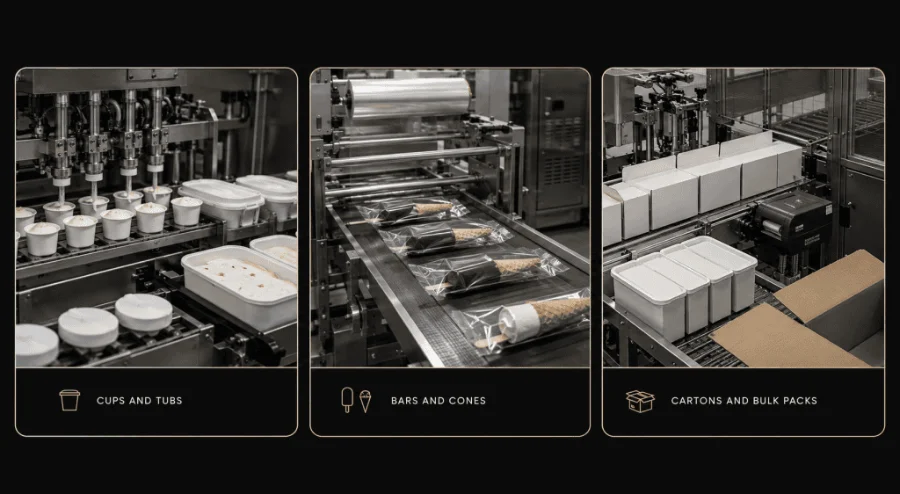
Ice cream has fragmented into more formats than almost any other chilled category – tubs, pints, cups, sticks, cones, sandwiches, multipacks. That fragmentation, not volume, is usually what makes the equipment decision hard.
Different Formats Are Different Systems
The single most expensive assumption in this category is that one line will cover the format range. A tub filler and a stick novelty line are different machines, not different settings. Before shortlisting anything, separate your formats into those you will run on one line and those that need their own.
Once that split is clear, the specification conversation becomes tractable. Before it is clear, every vendor quote is answering a different question.
Filling at Temperature
Product behaviour at filling temperature drives fill accuracy, and frozen dessert is unforgiving here. Overrun, viscosity and inclusion handling all shift with a few degrees. Specify accuracy at your actual filling temperature, and if you run inclusions – sauce ripples, cookie pieces, nut clusters – ask for the figure with them running.
A demonstration at a convenient temperature with smooth test media will not predict how the machine handles your product on a Tuesday in production.
Packaging That Survives Frozen Distribution
Frozen distribution is harder on packaging than chilled. Temperature cycling, condensation and handling through a cold chain all attack seal integrity and label adhesion. Packaging that passes inspection at the end of the line can still fail three weeks later in a retail freezer.
Specify seal performance against the distribution route you actually use, including any period of temperature cycling, rather than against a condition-controlled test.
Multipacks Are an End-of-Line Problem
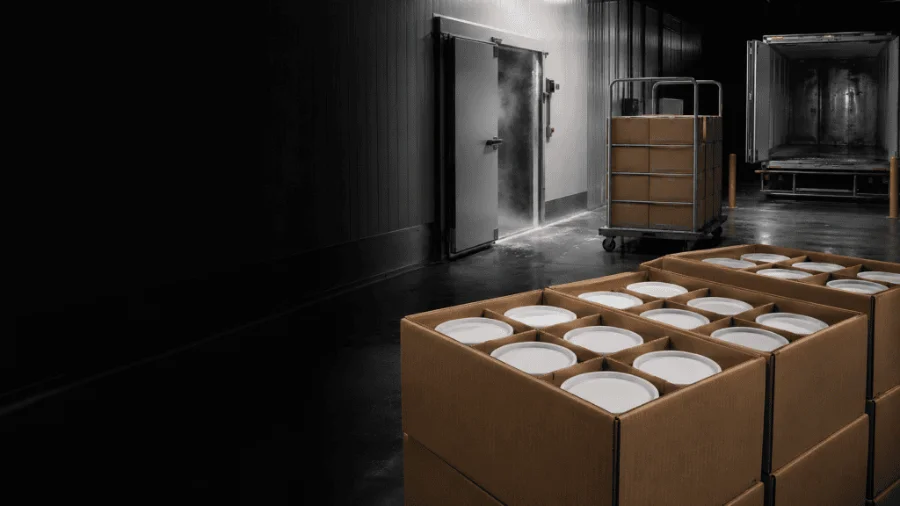
Single-serve multipacks are more packaging-intensive per unit of product than selling items individually, and that load lands at end of line: grouping, case packing, palletising. Producers who specify the filling stage carefully and treat end of line as an afterthought often find the bottleneck moves rather than disappears.
If multipacks are a growing share of your mix, specify the whole line rather than the filler.
Matching Equipment to Format
| System | Throughput | Frozen dessert fit |
|---|---|---|
| Cup Fill & Seal | 24-96 cups/min | Single-serve cups and small tubs |
| Form Fill & Seal | 100-300 units/min | Higher-volume runs with in-line formed packs |
| Tray Sealers | 40-180 trays/min | Multipack and tray-based presentations |
Automation typically takes 40-80% out of packaging labour with payback in 8 to 14 months. In frozen, the case for it is often as much about working in a cold environment consistently as about headcount.
Ask These Before Committing
- Which of my formats can genuinely run on one line, and which cannot?
- What fill accuracy holds at my filling temperature, with my inclusions?
- What seal performance do you guarantee through temperature cycling?
- What does end of line look like if multipacks double?
- Can I see it run my product, at temperature, with inclusions?
Overrun and Why It Complicates Filling
Overrun – the air incorporated into frozen dessert during freezing – is what makes the product scoopable, and it is also what makes accurate filling difficult. Product with high overrun is compressible, so a volumetric fill does not translate directly into a consistent weight.
If your products span a range of overrun, from dense premium to lighter economy lines, that range belongs in the specification. Ask how the machine handles compressible product, whether fill is controlled by volume or weight, and what accuracy is held across your overrun range rather than at a single value.
This is also why checkweighing matters more in frozen dessert than in many categories. Visual fill level and actual weight diverge in a way they do not with incompressible products.
Inclusions, Ripples and Variegates
Cookie pieces, nut clusters, chocolate chunks, sauce ripples and fruit swirls are what differentiate products in this category, and each one complicates the filling stage differently.
Particulate inclusions need dosing that does not crush or block. Ripples and variegates need a separate injection stage timed against the main fill, and the visual result – whether the swirl looks right through the container wall – is a quality specification even though it is aesthetic.
Establish which of your products carry inclusions, what the largest particle is, and whether any need a second dosing stage. Then ask to see the machine run the most difficult one. A demonstration on plain vanilla proves very little about a line that will spend most of its time running cookie dough.
Working in a Cold Environment
Frozen dessert lines often operate in chilled or frozen rooms, and that affects more than the product. Condensation forms on surfaces. Lubricants behave differently. Operators work slower and tire faster in cold conditions, and manual stages that are viable at ambient temperature become genuinely difficult.
This is part of why the automation case in frozen is often stronger than the labour arithmetic alone suggests. Consistency is harder to maintain manually in a cold room over a full shift, and the variability shows up in fill weights and seal quality.
Ask how the equipment is specified for cold operation: what is rated for the temperature, how condensation is managed, and what maintenance access looks like for a technician working in a freezer.
Hardening and Downstream Timing
Filled product usually passes through a hardening tunnel before packing, and that stage sets a rhythm the rest of the line must respect. Filling faster than hardening capacity simply builds a queue; packing faster than product emerges leaves equipment idle.
When specifying, work out the whole sequence rather than the filler in isolation. The useful number is sustained line output including hardening residence time, not the peak rate of any single machine. Producers who optimise the filler alone frequently find the constraint has simply moved downstream.
Planning frozen dessert packaging?
Tell us your format mix and volumes, and we’ll help work out what shares a line and what does not.
Get in Touch