
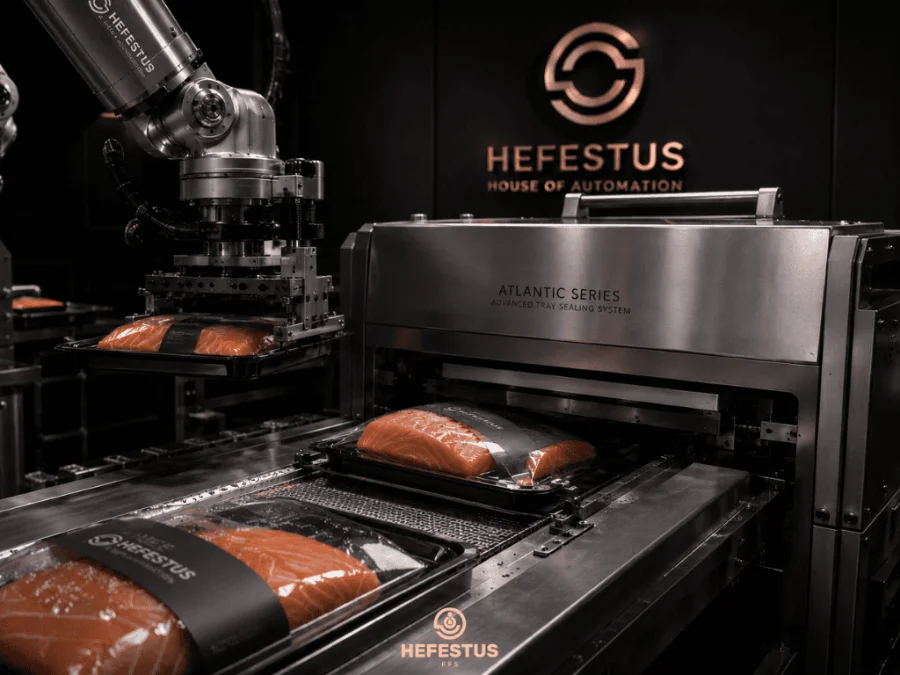
Three properties make seafood harder to package than almost anything else that moves through a chilled plant: it is wet, it is cold, and no two pieces are the same shape. Every specification decision downstream follows from those three, and a supplier who has not asked about all of them has not really scoped your line.
This is written for processors putting a brief together. If you are researching category growth and regional demand, that sits in our market coverage instead.
Everything Runs Wet
Fish and shellfish release moisture continuously, and the packs are handled in an environment that adds more of it. Brine, drip and condensation all end up on the one surface that must stay dry for the pack to survive distribution: the sealing area. A single failed closure does not just spoil one unit – it contaminates the retail display around it, and the recall exposure is disproportionate to the value of the pack.
So the question to press a vendor on is not whether the machine seals, but what it does about the moisture before it seals. Ask specifically about flange clearing, drip management between the filling and sealing stations, and whether the sealing tool has any positive method of dealing with a wet rim. Seal consistency is the single most operationally critical parameter in this category, and it is decided in the few centimetres before the tool closes.
Anti-fog film, precision profiling of seal temperature and pressure, and peel-test validation against your own product are the practical answers. Ask which of them are included and which are options.
Two Operating Temperatures, Two Sets of Problems
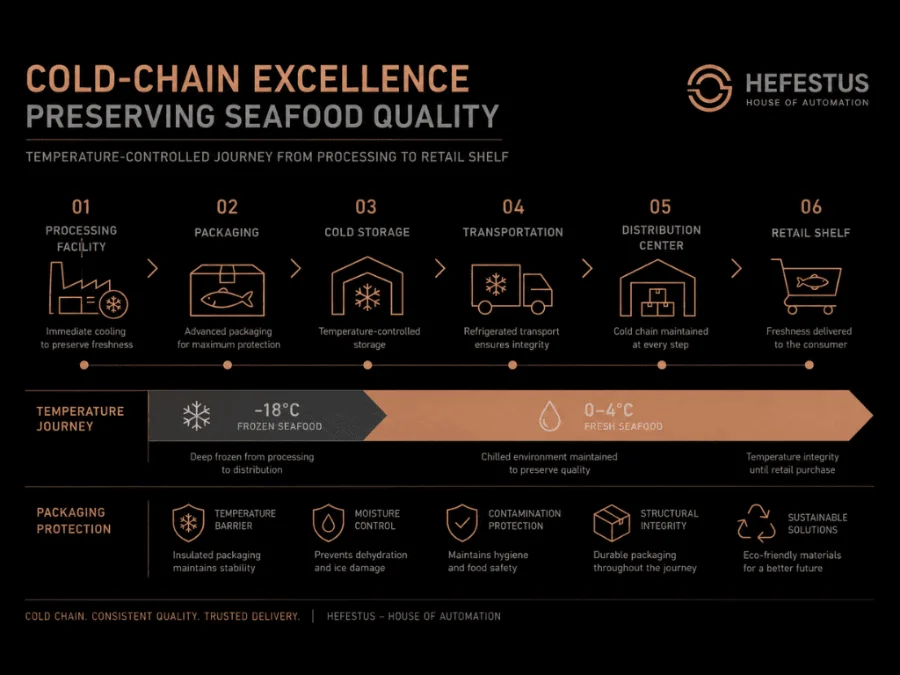
Fresh seafood holds at 0 to 4°C and frozen at −18°C or below. Those are not simply storage conditions; they are the conditions the equipment and the packaging material have to work in. The consequences show up as thermal stress on components, condensation forming on seal surfaces, and cold embrittlement in films that behaved perfectly in a warm demonstration room.
If any part of your line sits in the chilled hall, put the ambient temperature and humidity in the specification document. Then ask how the machine has been configured for it – heated seal tools behave differently in a cold room, pneumatics condense, and film that runs sweetly at room temperature can crack when it is fed cold. This is the single most common gap between a machine that demonstrated well and a machine that runs well.
Irregular Product Fights the Pack
Fillets vary in thickness, length and weight within the same grade. That variation drives three separate requirements. Tray depth has to accommodate the thickest portion you will actually run, not the average. Placement has to be accurate enough that nothing lands proud of the flange. And where the product is naturally uneven, vacuum skin packaging earns its place by drawing film down onto the contour, eliminating headspace and holding the piece still in transit.
Gas flushing takes the other route, replacing headspace air with a carbon dioxide and nitrogen blend, with controlled oxygen only where colour retention demands it. In practical terms: standard overwrap gives fresh fish three to five days, gas flushing pushes that to ten to eighteen days, and skin packs go further again while also reducing leakage. Decide which of those shelf-life outcomes your retailer requires before you decide which machine you want, because the answer determines the machine.
Allergens and Odour Are Line-Layout Issues
Crustaceans and molluscs are declarable allergens in most markets, so any line that runs both finfish and shellfish needs either physical separation or a validated cleaning procedure between them, with the evidence to show an auditor. That is a plant layout decision as much as an equipment decision, and it is far cheaper to make at specification stage than after installation.
Odour transfer is the less obvious one. Volatile compounds carry into porous materials, seals, belts and enclosed spaces, and they do not always come out with a standard washdown. If the same equipment will ever handle a non-seafood product, raise it early – the answer may be dedicated contact parts rather than shared ones.
Frozen Formats Have Their Own Rules
Frozen lines rely on multilayer films for their moisture and puncture resistance, usually built on polyethylene, polypropylene or polyester with an EVOH layer where oxygen barrier matters. Films rated below 0.1 cc/m²/day of oxygen transmission are what prevent freezer burn over a long frozen shelf life.
Two things change on the equipment side. Flexible formats such as pouches and shrink films can weigh up to 75% less than an equivalent rigid pack, which improves your cube efficiency and your freight cost but demands a machine that handles limp material accurately. And where product is individually frozen and free-flowing, dosing becomes a weighing problem rather than a placement problem, which is a different machine entirely.
Export adds a documentation layer on top. Shipments have to satisfy the labelling, traceability and food safety rules of the destination, so coding, lot marking and inspection are functional requirements on the line, not administrative afterthoughts.
Washdown Is a Structural Requirement
Seafood equipment is cleaned aggressively – hot water, caustic chemistry, high pressure, every day – and it has to hold sealing tolerances afterwards. That means stainless construction, IP69K-rated controls, sanitary drive systems and crevice-free design as a starting point rather than an upgrade path. FDA and USDA compliance, ISO 9001 and CE certification confirm the framework around it.
Ask to see the machine mid-clean, not just running. How much comes apart without tools, how long does the crew need, and how quickly does the line return to a validated state? Sanitation hours are hours the line is not producing, and on a short-shelf-life product they are expensive hours.
Sizing Against Real Availability
Rated speed is the least informative figure a supplier will give you. Take the packs you must produce in a week, divide by the hours the line is genuinely available after sanitation and changeovers, and treat that as your requirement.
| System | Rated throughput | Where it fits in seafood |
|---|---|---|
| Tray Sealers | Depends on tray size & format | Fresh portions, retail-ready trays, gas-flushed and skin packs |
| Form Fill & Seal | 100-300 units/min | Frozen pouches, shrink formats and high-volume flexible packs |
| Cup Fill & Seal | 30–120 cups/min | Prepared seafood, salads, dips and portioned foodservice packs |
For reference, thermoform-fill-seal systems working from roll-fed material commonly exceed 100 packs per minute in industrial use, which is why point-of-processing packaging – sealing the product immediately after it is portioned – has become the quality benchmark rather than an aspiration.
The Automation Case, Specific to Seafood
Recruitment for repetitive packaging roles in cold, wet halls is structurally difficult, not a temporary shortage. That pressure is worth pricing from your own headcount and turnover rather than from a vendor average. The seafood-specific gains sit in four places:
- Portion placement – consistent positioning in the tray, which is what protects the flange from product contact.
- Atmosphere and seal – gas flushing and closure repeated identically instead of varying by operator and by hour.
- Inline inspection – vision-based seal checking and defect detection before the pack joins a pallet.
- End of line – labelling, coding, case packing and palletising, where export documentation requirements land.
In a category where one leaking pack can trigger a recall, the value of doing the same thing every time is easier to quantify than the labour saving.
Take This List to the Demo
- How does the machine clear moisture from the seal area before the tool closes?
- What ambient temperature and humidity is this configuration rated for?
- Run my thickest and my thinnest fillet through it – what changes?
- How do you validate a seal, and can I have the peel-test data on my film?
- What is the cleaning procedure between shellfish and finfish, and how is it evidenced?
- Which contact parts are dedicated, and which are shared across products?
Run the demonstration with your product at your temperature. A room-temperature trial with substitute media will confirm that the machine seals; it will tell you nothing about whether it seals wet fish in a cold room, which is the only question that matters.
What This Comes Down To
Specify the moisture problem before the speed problem. State the operating temperature of the hall, not just of the product. Size the tray around your largest portion rather than your average one. Settle the required shelf life first, because it selects between skin packs and gas flushing rather than the other way round. Treat allergen separation as a layout decision made now. And validate everything on your own fish, cold.