
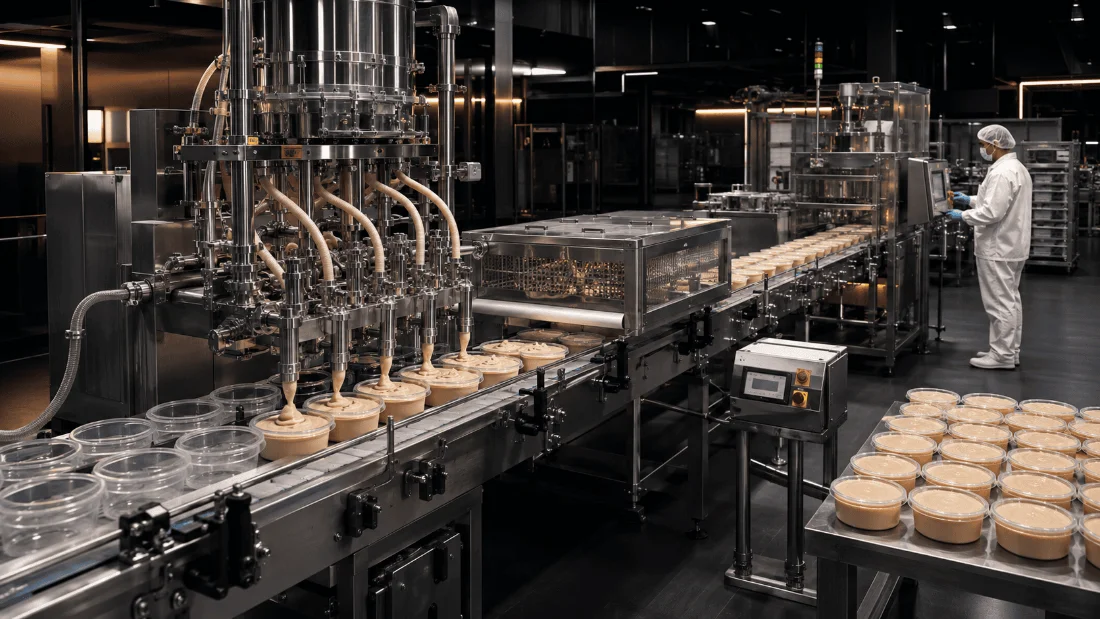
Hummus has quietly become one of the biggest success stories in the refrigerated foods aisle, and that success is now colliding with a hard operational problem – capacity. As demand climbs, hummus producers are running into the limits of what their filling and sealing equipment can handle, which is why the hummus packaging lines market has become a topic worth watching closely for equipment manufacturers, co-packers, and food industry investors alike.
This guide breaks down the hummus packaging lines market size, share by technology and format, and, just as importantly, why this niche but critical equipment category is growing.
Hummus Packaging Lines Market Overview
A decade ago, hummus was a specialty item tucked into the “ethnic foods” section of the grocery store. Today, it’s a mainstream refrigerated dip sitting in the regular dairy or deli case of nearly every major supermarket in North America and Europe, with fast-growing adoption across Asia-Pacific and the Middle East.
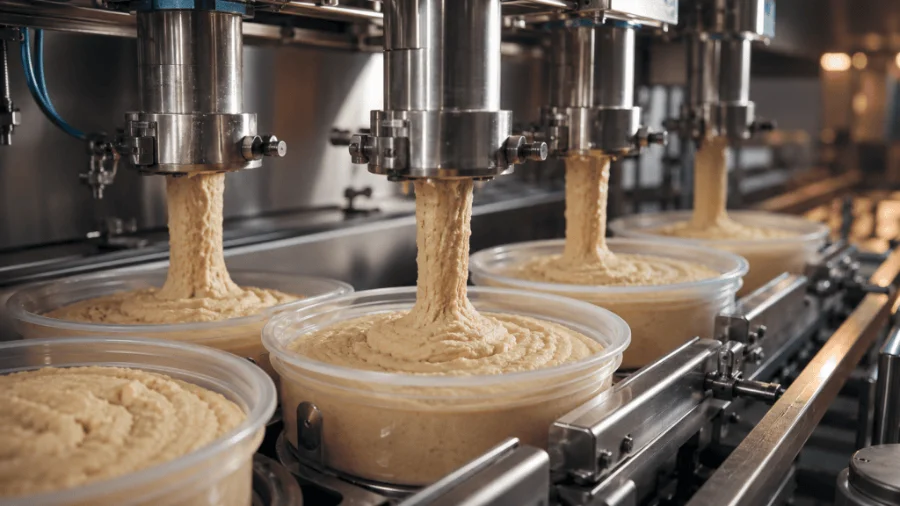
That mainstreaming has created a supply-side problem that doesn’t get talked about as often as the consumer trend itself – rising hummus consumption puts direct pressure on filling and sealing capacity. Hummus isn’t a simple liquid. It’s a thick, semi-viscous paste with oil separation tendencies, and packaging it well (cleanly, consistently, and at scale) requires purpose-built equipment, not generic filling lines borrowed from other food categories.
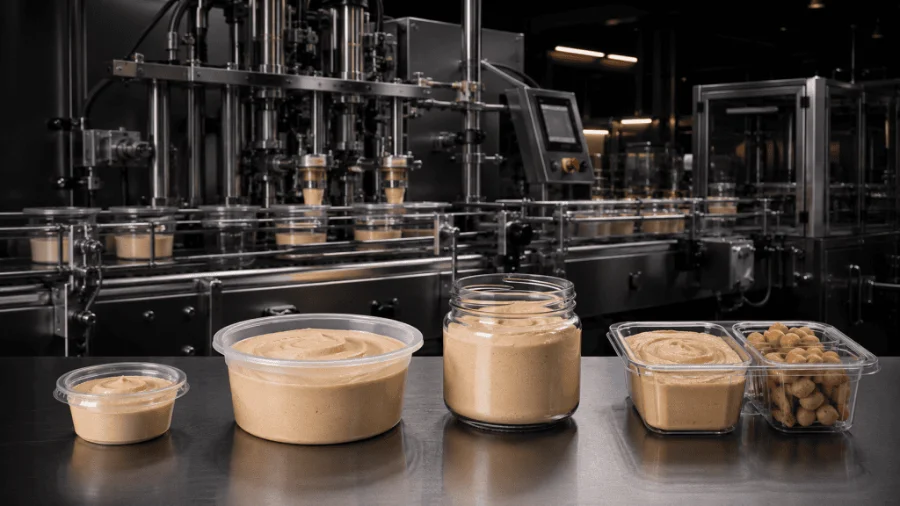
Producers scaling up need packaging lines that can handle:
- Single-serve cups and portion packs
- Family-size tubs
- Premium glass jars for specialty and gourmet lines
- Multi-compartment trays (hummus plus crackers, veggies, or pita)
Hummus Packaging Lines Market Size
Two of the most-cited industry sources on hummus packaging equipment, Market Intelo and Growth Market Reports, put the global hummus packaging lines market in a similar range, though their specific figures differ:
| Source | Market Size | Forecast | CAGR |
|---|---|---|---|
| Market Intelo | $1.2B in 2025 | $1.8B by 2034 | 5.8% |
| Growth Market Reports | $1.14B in 2024 | $1.96B by 2033 | 6.2% |
While the two estimates aren’t identical, they converge on the same overall picture – a market in the low-to-mid single-digit billions, growing at a mid-single-digit-to-high-single-digit CAGR through the early 2030s. For sourcing decisions or investment theses, it’s worth treating these as directional estimates rather than precise figures, and cross-checking against a report’s full methodology before citing a single number as definitive.
Hummus Market Size and Packaging Demand
Packaging equipment demand doesn’t exist in a vacuum; it’s a downstream function of how much hummus is actually being produced and sold. Industry estimates from Mordor Intelligence put the underlying hummus product market at:
| Metric | Figure |
|---|---|
| Hummus market size, 2026 | $4.43B |
| Hummus market forecast, 2031 | $6.02B |
| CAGR | 6.33% |
| Largest market | North America |
| Fastest-growing market | Middle East & Africa |
The connection is clear. Rising hummus volume requires reliable and fast packaging lines. Because hummus has a short shelf life, excellent sealing prevents spoilage and leaks. Any bottleneck in the packaging line directly caps sales.
Market size estimates vary by research provider. Growth projections depend heavily on how researchers define the market scope. Some studies include adjacent dips or foodservice data while others focus strictly on retail hummus. Producers should confirm these methodologies before using the data for business planning.
Hummus Market Share by Packaging Type
Not all hummus packaging formats are growing at the same rate, and that divergence is exactly what’s shaping equipment investment decisions right now.
| Packaging Type | Share / Growth |
|---|---|
| Cups, tubs, and jars | 69.58% share in 2025 |
| Bottles | Fastest growth at 7.66% CAGR |
| Pouches | Smaller but relevant |
| Other formats | Specialty uses |
Cups, tubs, and jars dominate hummus market share for one simple reason – hummus is primarily sold as a refrigerated dip, and refrigerated dips need packaging that supports easy storage, resealability, portion control, and shelf visibility. Supermarket tubs must stack easily and reseal cleanly after opening. They also need a clear lid to showcase the product. Cups, tubs, and jars handle these specific retail demands better than any other packaging format.
Bottles are the fastest-growing packaging format. This growth follows a consumer demand for squeeze-and-go products. The trend comes from the condiments category and now applies to hummus. These bottle formats work best for thinner, dressing-style hummus variants.
Automatic vs Semi-Automatic Hummus Packaging Lines
Technology choice is where the packaging-lines story gets genuinely interesting, because it maps directly onto business size and strategy.
| Technology | Share |
|---|---|
| Automatic | 52.3% |
| Semi-automatic | 31.8% |
| Manual | 15.9% |
Automatic packaging lines lead the market because they provide essential benefits like speed, fill accuracy, and strong hygiene. These systems reduce labor dependency and keep sealing consistent at scale. For high-volume national brands, the return on investment comes quickly. Lower labor costs and higher production yields compound rapidly. Automated tracking also helps meet strict food safety regulations by improving traceability.
Semi-automatic setups offer a practical alternative for growing businesses. They occupy a useful middle ground for regional brands, private-label producers, and expanding artisanal operations. These lines boost throughput well above manual speeds without requiring massive capital investments. Meanwhile, manual lines remain viable only for small-batch craft producers. Low production volumes make expensive machinery economically unnecessary.
Why Hummus Packaging Machines Are in Demand
From an engineering standpoint, hummus is a genuinely difficult product to package well. That difficulty is a big part of why purpose-built packaging lines command a premium over generic filling equipment:
- Thick and viscous paste – Hummus resists liquid flow and complicates precise volumetric filling.
- Container rim smearing – Excess paste on rims causes sealing failures and contamination risks.
- Mid-run oil separation – Separating olive oil alters product consistency and reduces filling accuracy.
- Trapped air pockets – Hidden air bubbles distort visual fill levels and ruin weight checks.
- Strict shelf-life needs – Clean-label formulas lack preservatives and require perfect seals to prevent spoilage.
- Retail uniformity demands – Supermarkets require identical cup fills, label placements, and lid seating.
- High SKU complexity – Rapid flavor variations require fast machinery changeovers without long manual delays.
This combination of technical difficulty and rising SKU complexity is exactly why demand for specialized hummus packaging equipment is outpacing generic food-packaging equipment growth in adjacent categories.
Key Hummus Packaging Lines Market Takeaways
| Category | Key Takeaway |
|---|---|
| Packaging lines market | Around $1.14B-$1.2B in 2024/2025 |
| Forecast | Around $1.8B-$1.96B by 2033/2034 |
| Hummus market size | Forecast to reach $6.02B by 2031 |
| Leading hummus format | Cups, tubs, and jars |
| Leading region | North America |
| Leading technology | Automatic packaging lines |
| Machine implication | Producers need accurate, hygienic filling and sealing |
Final Takeaway
The hummus packaging lines market is a small but strategically important slice of the broader food packaging equipment industry. Its growth trajectory is inseparable from the hummus category’s own rise from a specialty item to a supermarket staple. As hummus consumption climbs toward an estimated six billion dollars globally by the early 2030s, the pressure on producers to invest in faster, more precise, and more flexible packaging lines will only intensify.
For equipment manufacturers, the opportunity lies in solving hummus’s specific packaging challenges rather than treating it as just another dip or spread. Success means designing machinery that handles viscosity, oil separation, rim cleanliness, and rapid SKU changeovers. For producers, the message is equally clear. Packaging capacity, not recipe innovation, may be the real bottleneck standing between them and market share growth.