
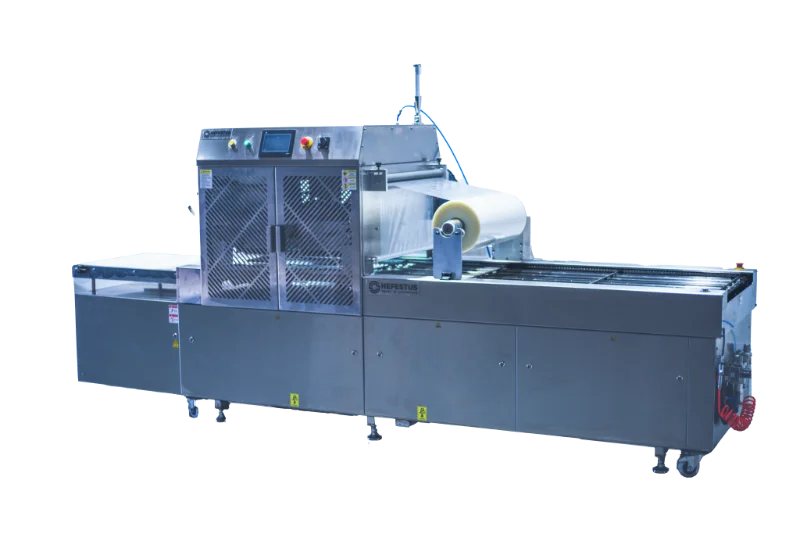
Tray sealers take pre-made trays, seal a lidding film across them and discharge the finished pack, with or without a gas flush for modified atmosphere. Simpler and smaller than a thermoformer, at the cost of buying and storing the trays.
Ideal for: Frozen meals, bakery, deli, fresh prepared foods
Published specifications, model by model
Models & technical specifications
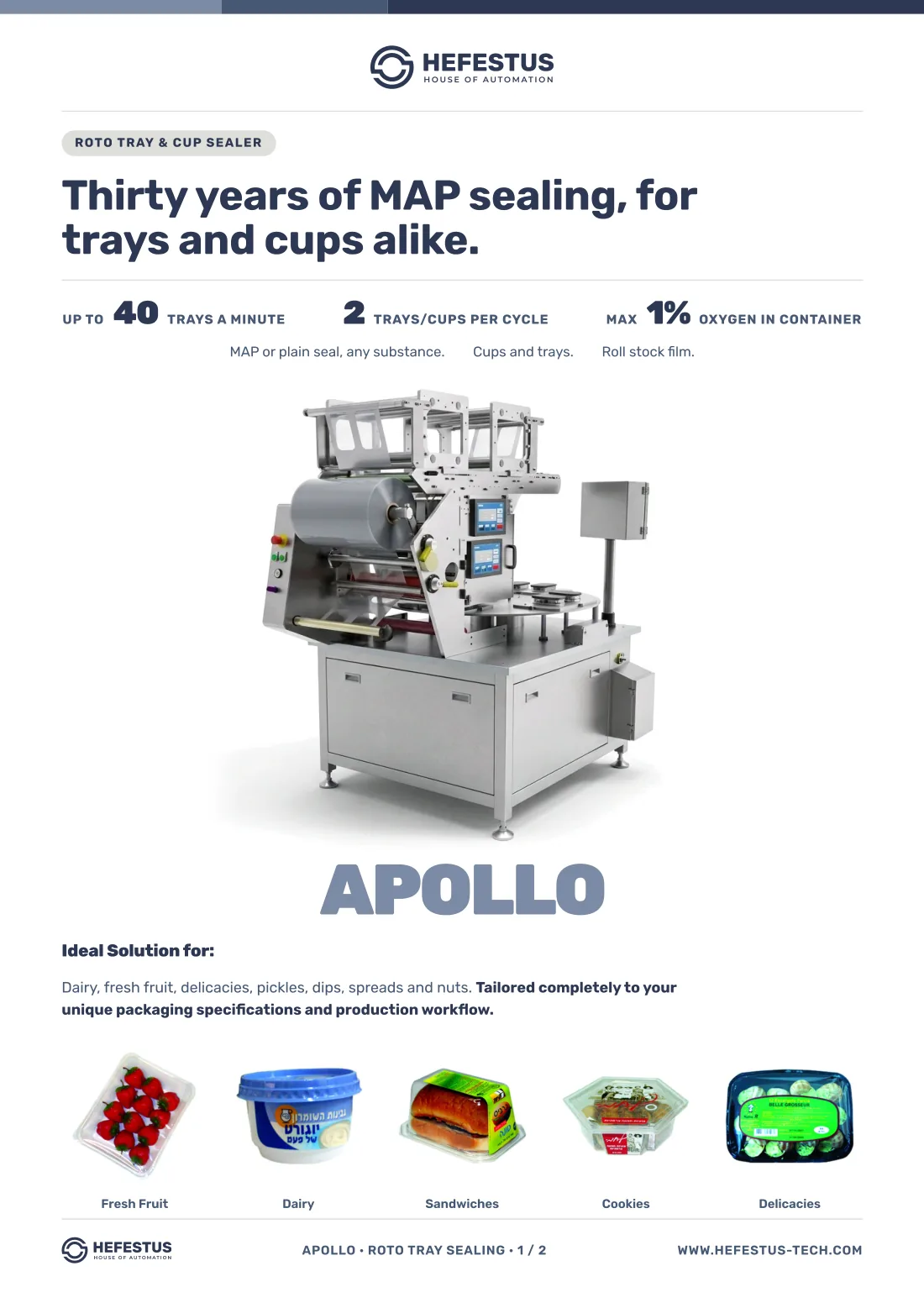
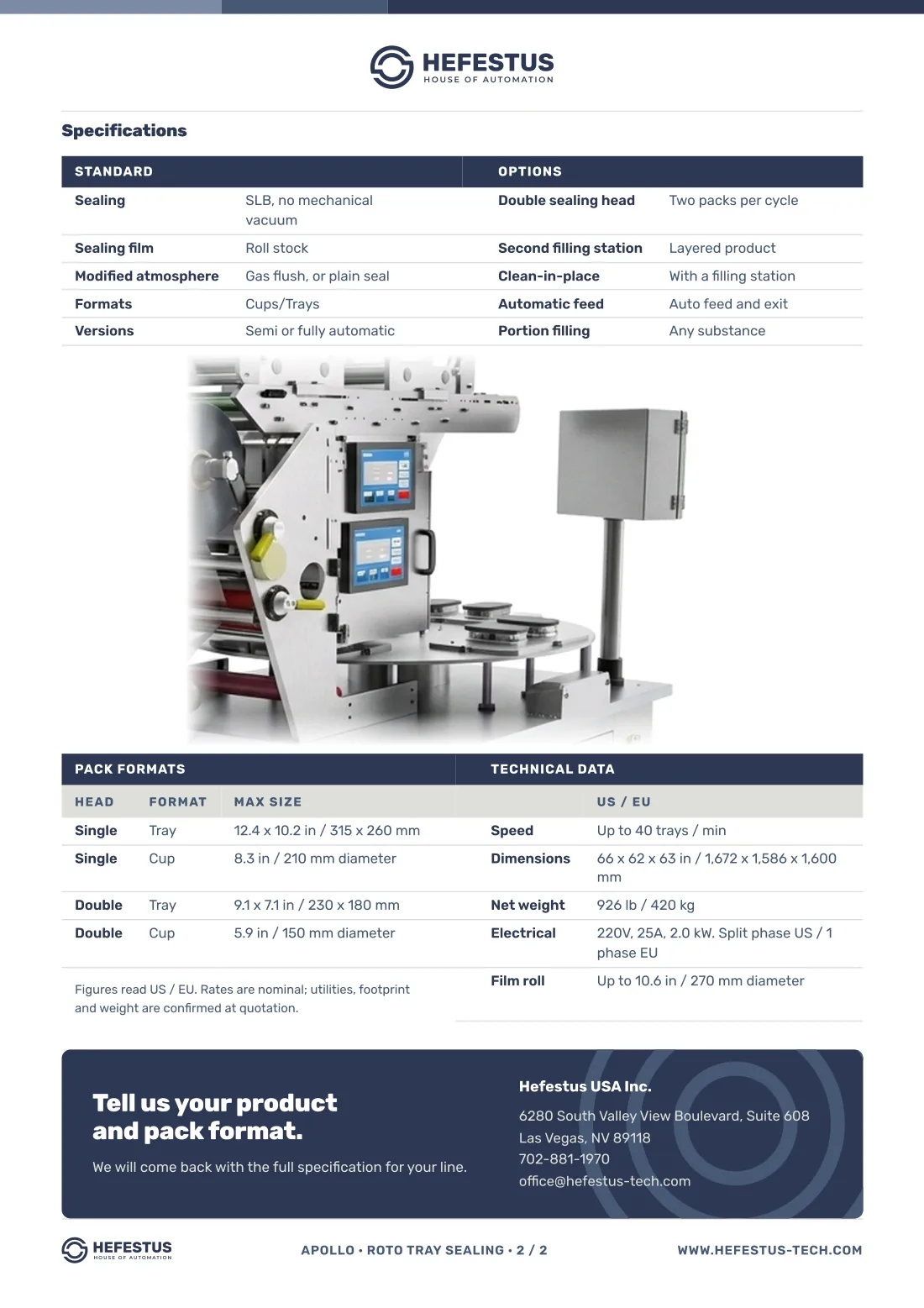
| Speed | Up to 40 trays per minute, 2 trays or cups per cycle |
|---|---|
| Residual oxygen | Max 1% in container |
| Single tray | 315 × 260 mm max |
| Double tray | 230 × 180 mm max |
| Single cup | 210 mm diameter max |
| Double cup | 150 mm diameter max |
| Sealing | SLB, no mechanical vacuum. Gas flush or plain seal |
| Sealing film | Roll stock, up to 270 mm roll diameter |
| Dimensions | 1,672 × 1,586 × 1,600 mm |
| Net weight | 420 kg |
| Electrical | 220V, 25A, 2.0 kW — split phase USA / 1 phase Europe |
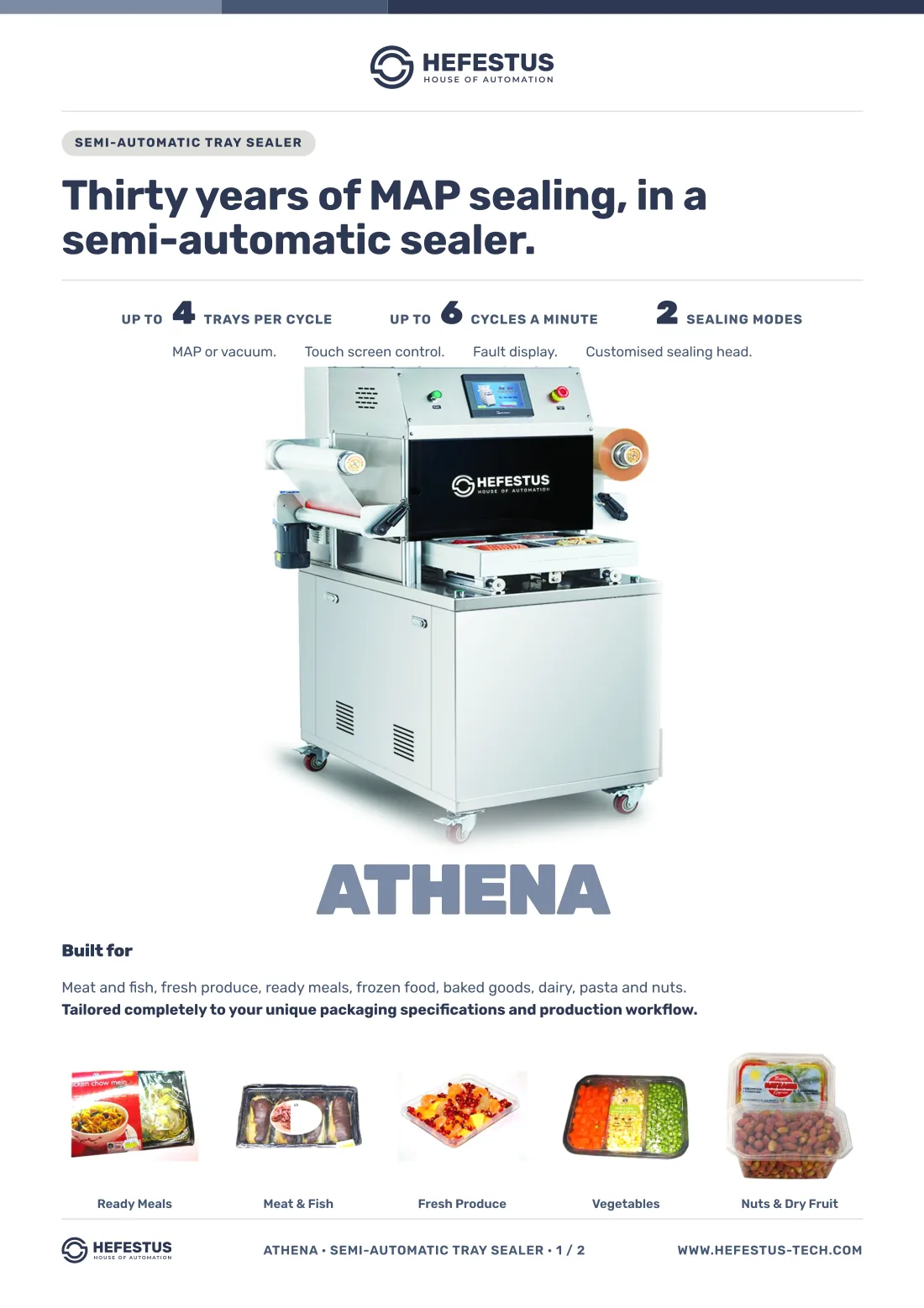
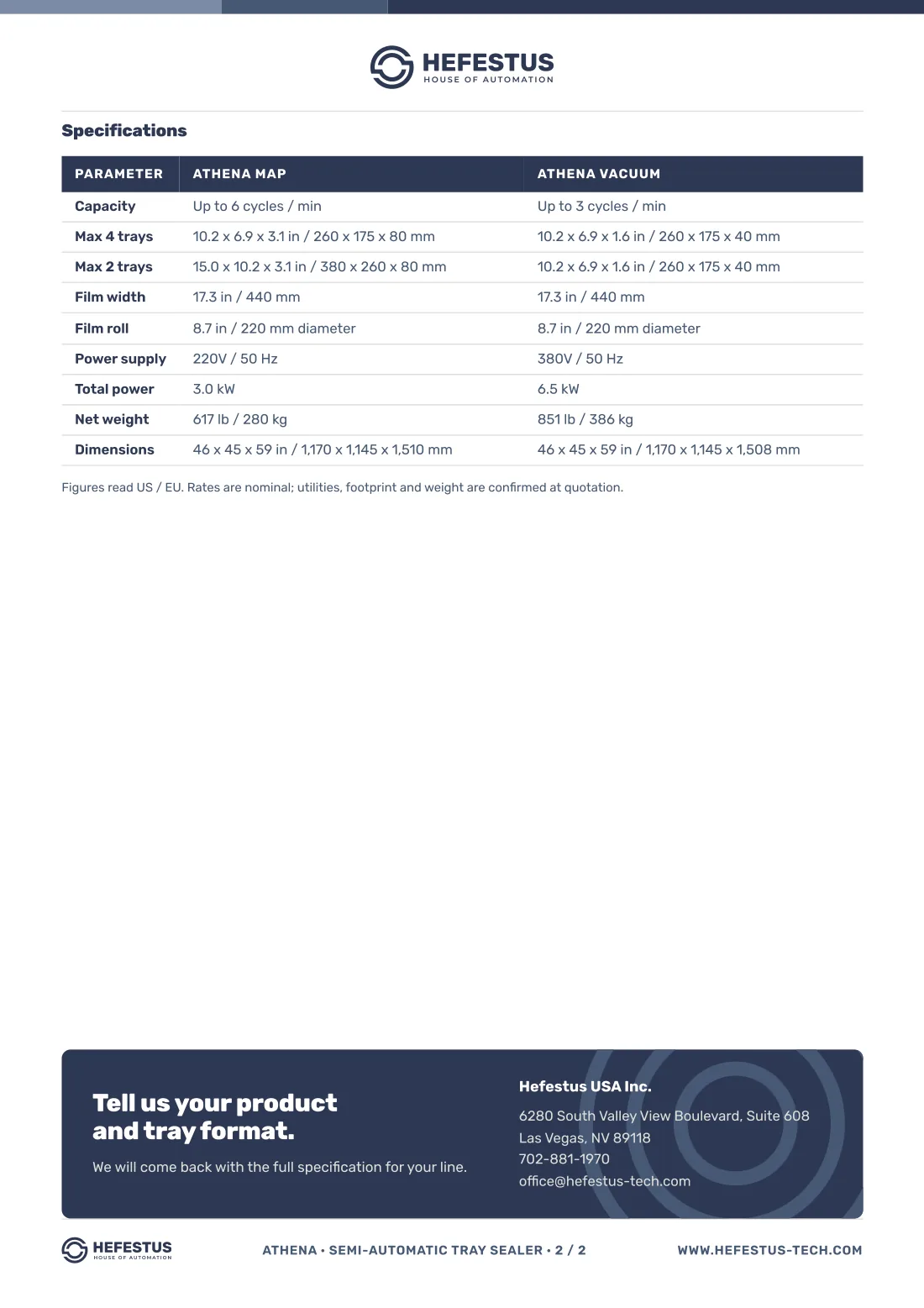
| Capacity | MAP up to 6 cycles/min · Vacuum up to 3 cycles/min |
|---|---|
| Max 4 trays | MAP 260 × 175 × 80 mm · Vacuum 260 × 175 × 40 mm |
| Max 2 trays | MAP 380 × 260 × 80 mm · Vacuum 260 × 175 × 40 mm |
| Film | 440 mm wide, up to 220 mm roll diameter |
| Power supply | MAP 220V / 50 Hz · Vacuum 380V / 50 Hz |
| Total power | MAP 3.0 kW · Vacuum 6.5 kW |
| Dimensions | 1,170 × 1,145 × 1,510 mm (MAP) · 1,170 × 1,145 × 1,508 mm (Vacuum) |
| Net weight | MAP 280 kg · Vacuum 386 kg |
| Control | Touch screen with fault display |
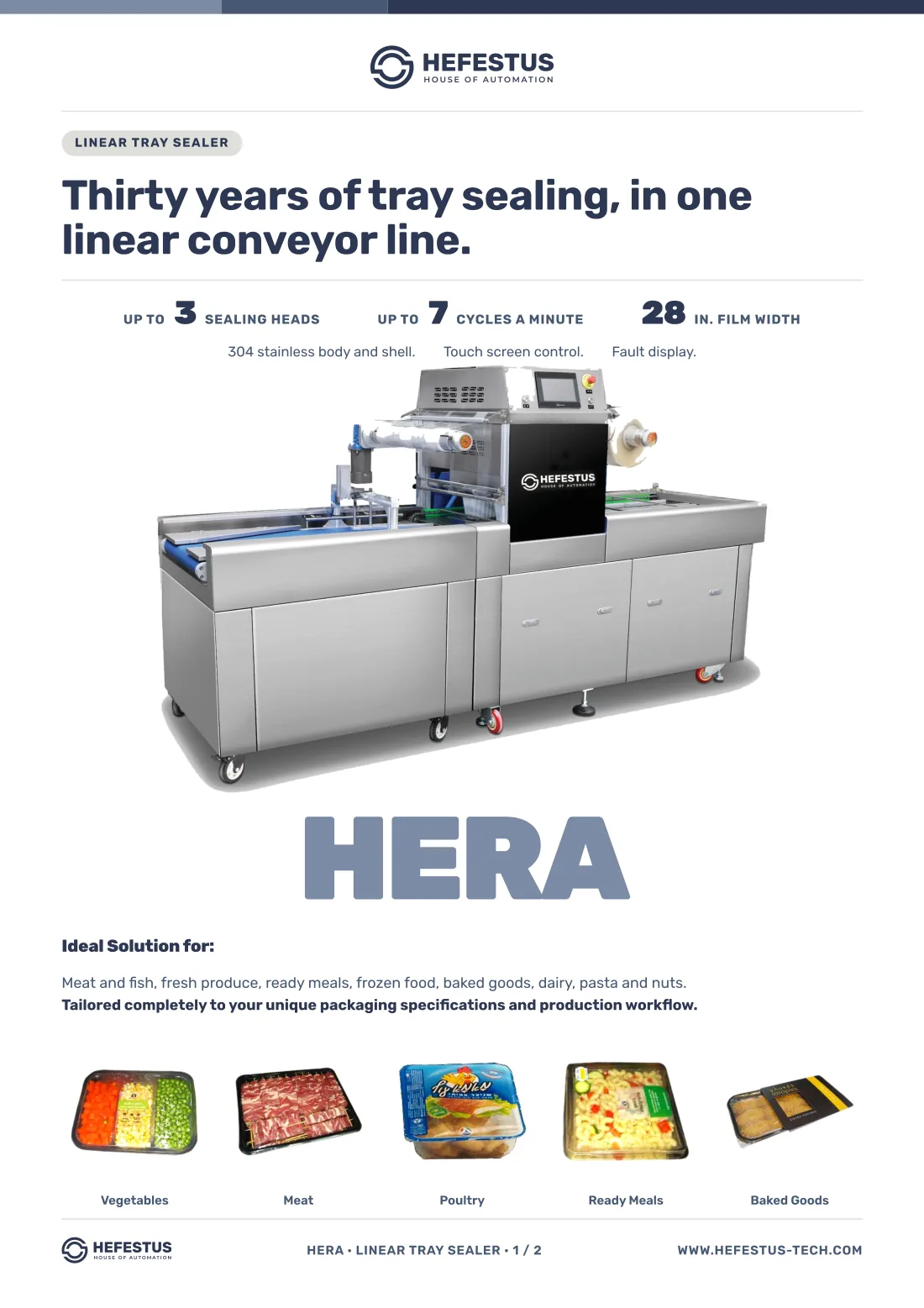
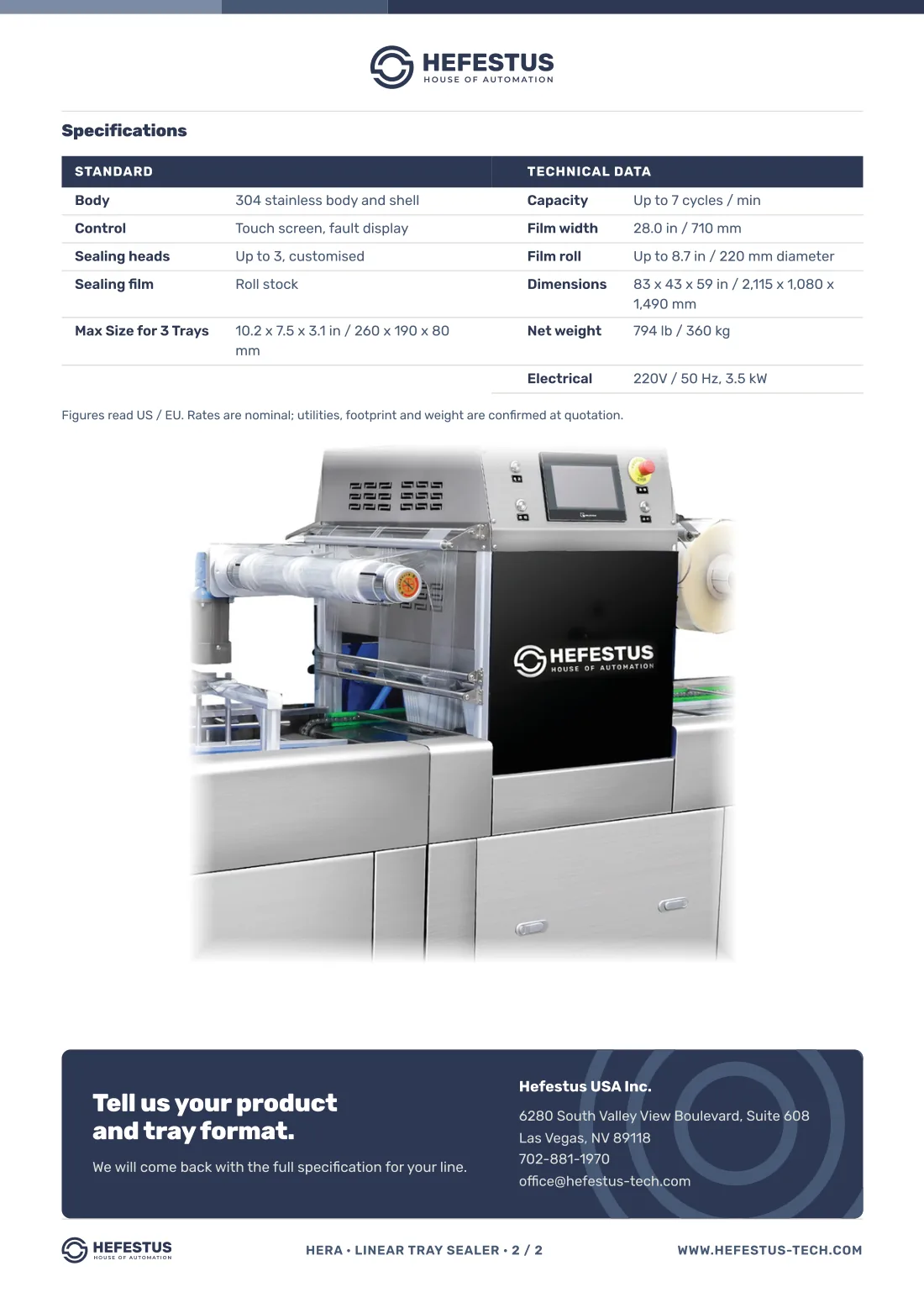
| Capacity | Up to 7 cycles per minute; no trays-per-minute figure is published |
|---|---|
| Sealing heads | Up to 3, customised |
| Max size, 3 trays | 260 × 190 × 80 mm |
| Film | 710 mm wide, up to 220 mm roll diameter |
| Structure | 304 stainless body and shell |
| Control | Touch screen with fault display |
| Dimensions | 2,115 × 1,080 × 1,490 mm |
| Net weight | 360 kg |
| Electrical | 220V / 50 Hz, 3.5 kW |
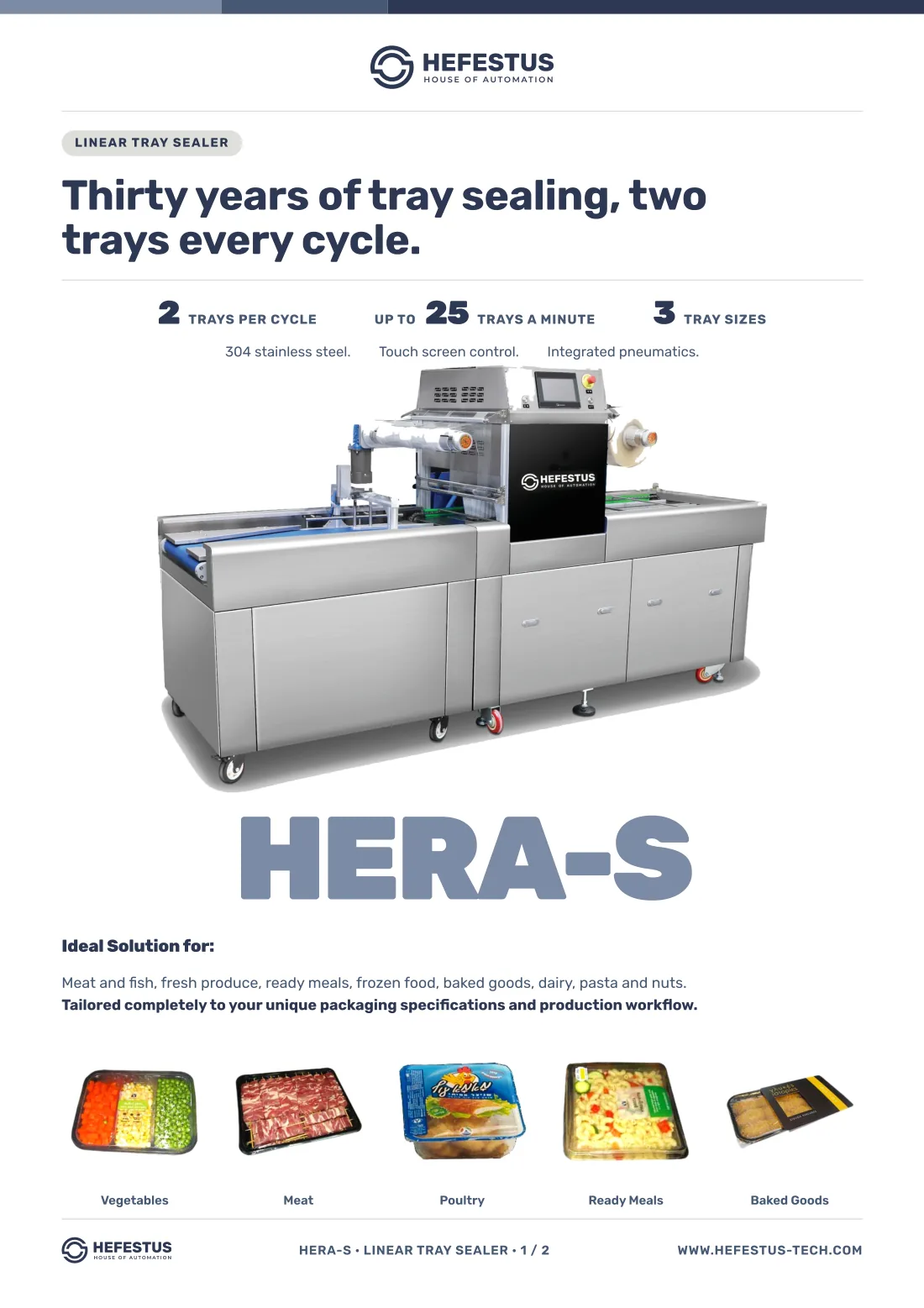
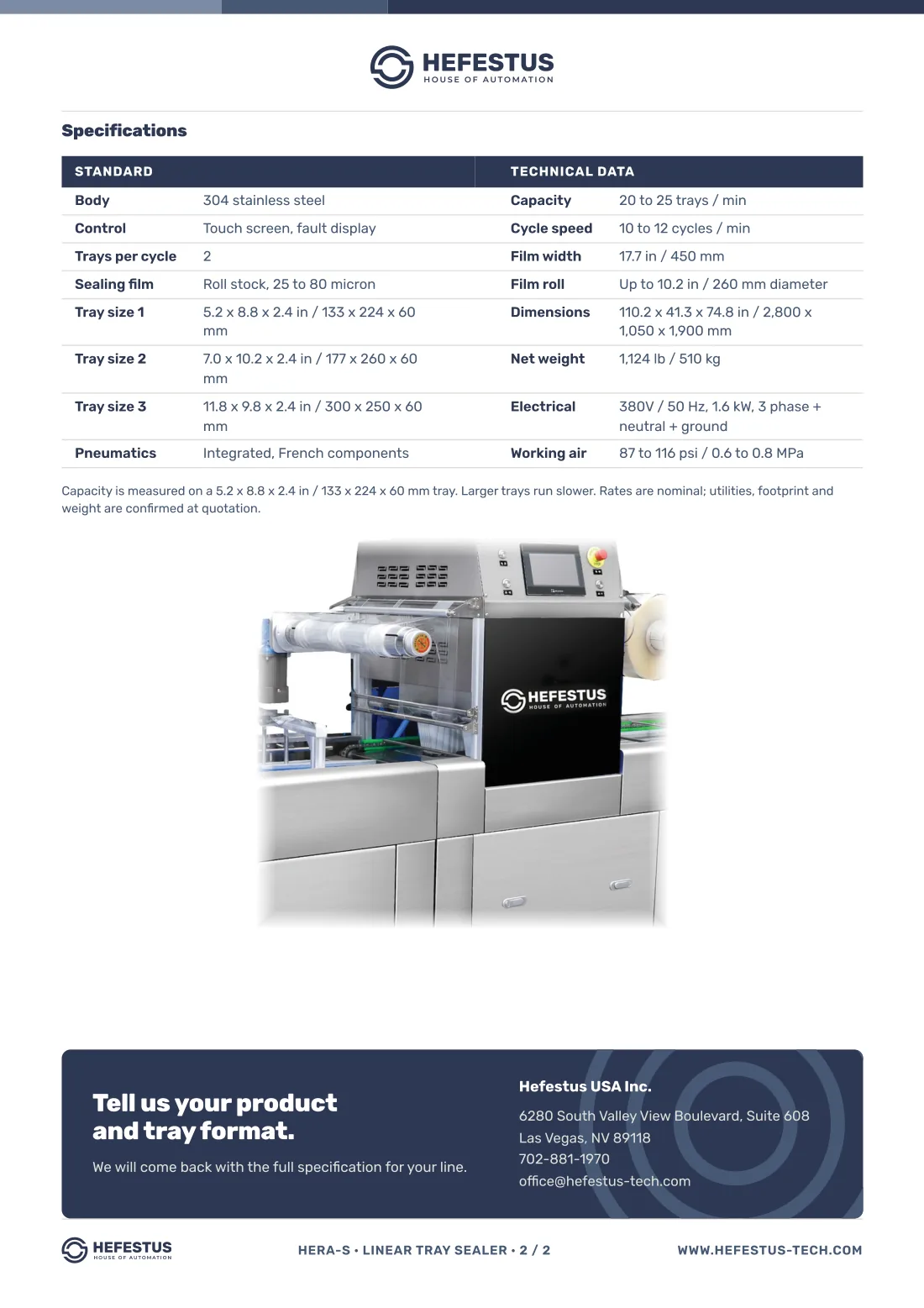
| Capacity | 20 to 25 trays per minute, 10 to 12 cycles per minute |
|---|---|
| Trays per cycle | 2 |
| Tray sizes | 133 × 224 × 60 mm · 177 × 260 × 60 mm · 300 × 250 × 60 mm |
| Film | Roll stock 25 to 80 micron, 450 mm wide, up to 260 mm roll diameter |
| Structure | 304 stainless steel |
| Control | Touch screen with fault display |
| Pneumatics | Integrated, French components. Working air 0.6 to 0.8 MPa |
| Dimensions | 2,800 × 1,050 × 1,900 mm |
| Net weight | 510 kg |
| Electrical | 380V / 50 Hz, 1.6 kW, 3 phase + neutral + ground |
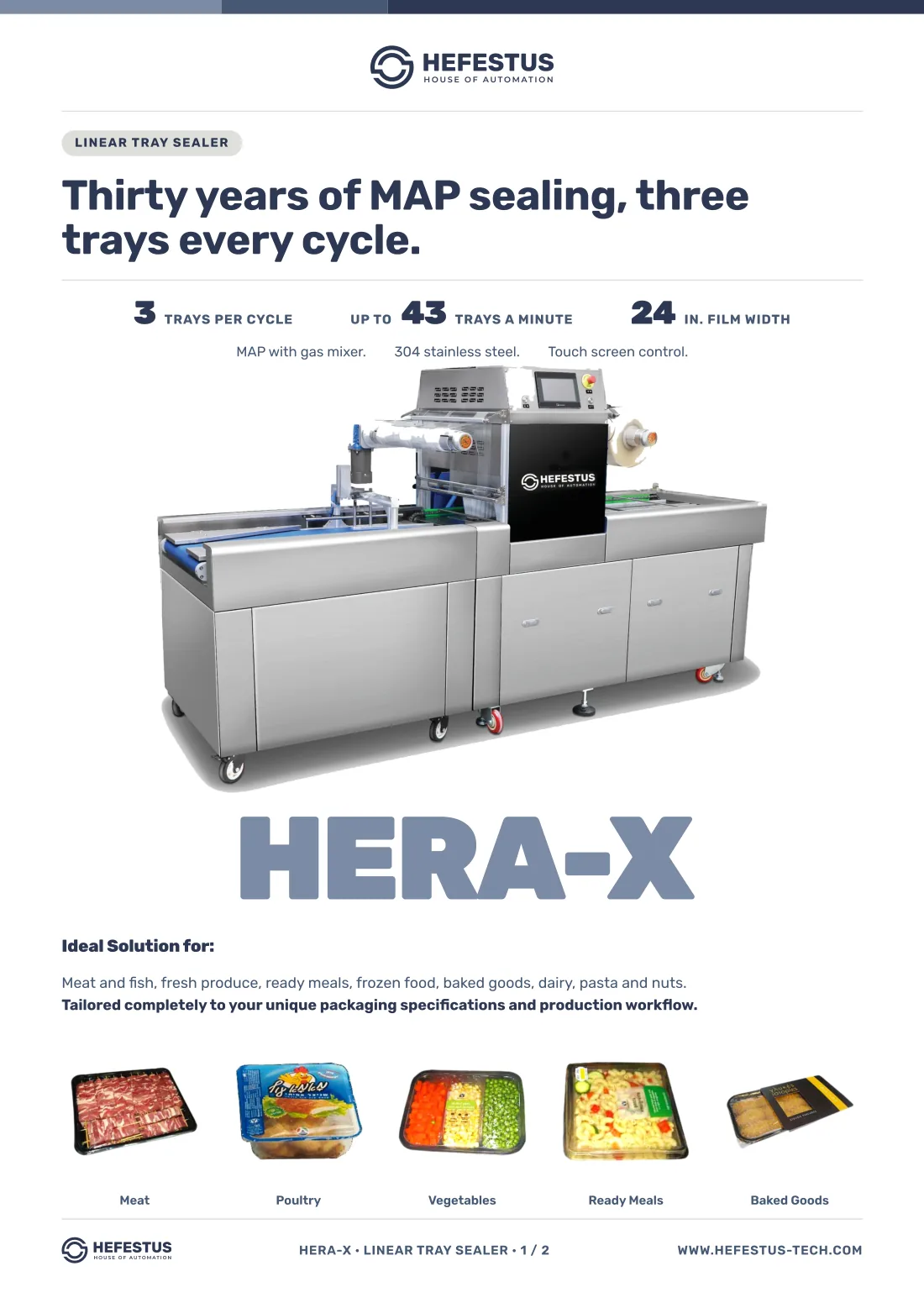
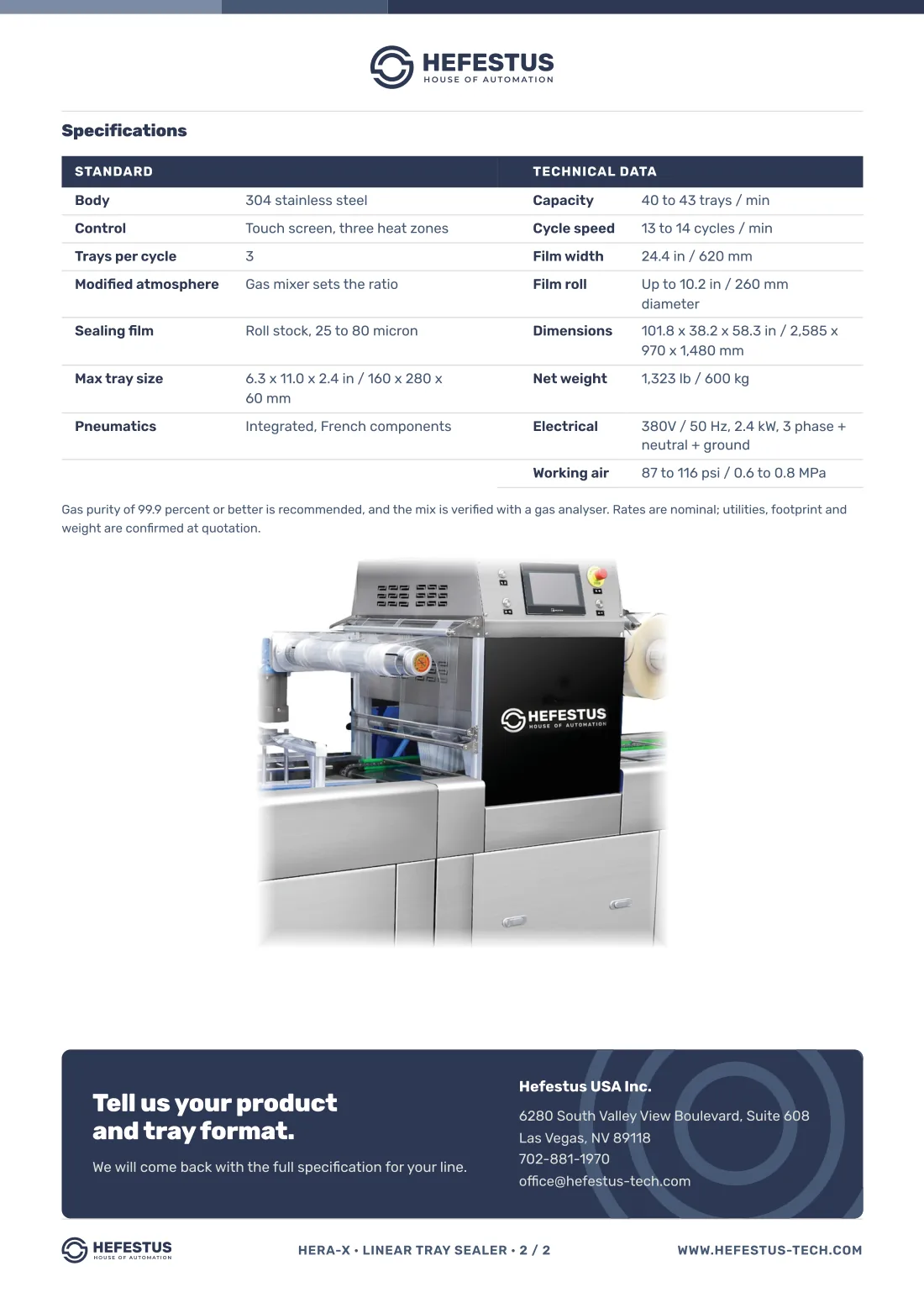
| Capacity | 40 to 43 trays per minute, 13 to 14 cycles per minute |
|---|---|
| Trays per cycle | 3 |
| Max tray size | 160 × 280 × 60 mm |
| Modified atmosphere | Gas mixer sets the ratio; 99.9% purity or better recommended, verified with a gas analyser |
| Film | Roll stock 25 to 80 micron, 620 mm wide, up to 260 mm roll diameter |
| Structure | 304 stainless steel |
| Control | Touch screen, three heat zones |
| Pneumatics | Integrated, French components. Working air 0.6 to 0.8 MPa |
| Dimensions | 2,585 × 970 × 1,480 mm |
| Net weight | 600 kg |
| Electrical | 380V / 50 Hz, 2.4 kW, 3 phase + neutral + ground |
Specifications as published in the Hefestus machine specification sheets. Rates are nominal; utilities, footprint and weight are confirmed at quotation.
Spec sheets
Open any sheet below to read it on this page. Each is two pages, and every figure on them also appears in the table above.
Who tray sealing suits
Tray sealing suits operations running several formats, moderate volumes, or products where the tray itself is part of the presentation. You carry the cost of bought-in trays and somewhere to keep them, and in exchange you get a smaller, simpler machine and the freedom to change tray supplier without touching it. Vacuum skin packaging — film drawn tight over the product on a board, used for premium meat and fish — is a different machine class again, not a setting on a tray sealer. Athena runs a vacuum mode, but that is vacuum tray sealing, which is not the same thing.
The labour arithmetic, done properly
Count the people on the sealing operation now, across every shift, and include the ones who only cover breaks. Multiply by your loaded hourly cost rather than the wage. Then add what you currently lose to reworked and rejected packs, which is usually the number nobody has to hand and often rivals the labour figure. That total is what an automated sealer is bidding against. Set against it the machine, the installation, the electrical work, and the trays you will go on buying, because those do not go away.
What a tray sealer will not do
It seals trays. It does not fill them, so if your filling is manual that becomes the constraint the moment the sealer runs, and you have moved the bottleneck rather than removed it. It will not form a pack, so tray cost and tray storage stay with you. Trays outside the published sizes need tooling. And if you need film drawn tight over the product rather than a flat lid, that is vacuum skin packaging — a different machine class, not a setting on this one. Ask us before you assume either way.
Switching tray formats
A tray format change means a tooling change. The question worth asking is not how long one change takes but how many you run a week, because that number multiplied by the honest changeover time is capacity that appears on no data sheet. Grouping SKUs that share a tray footprint gets noticeably more out of the same machine.
Check these against your line first
- Your tray sizes. Each model publishes its own maximum tray envelope, above. Check yours against them before anything else, because geometry rules a machine out faster than speed does.
- Gas flush rate. Ask for the rate with modified atmosphere at your tray size, sustained across a shift, not the headline figure.
- Electrical supply. Apollo runs on 220V, 25A, 2.0 kW; Hera on 220V / 50 Hz at 3.5 kW; Athena on 220V at 3.0 kW for MAP and 380V at 6.5 kW for vacuum. Confirm the configuration for your country before shipping.
- Compressed air. Working pressure is 0.6 to 0.8 MPa. Check your compressor has the headroom, because a new one is its own capital purchase.
- Skin or seal. Vacuum skin packs are a different machine class from tray sealing. Athena’s vacuum mode seals trays under vacuum, which is not the same thing — say which you need.
Tray sizes, weights, electrical load and working pressure are published above because they decide whether a machine can be installed at all, long before anyone discusses price. Where a figure is not published for a given model we would rather leave the gap visible than fill it with the number from its sibling.