
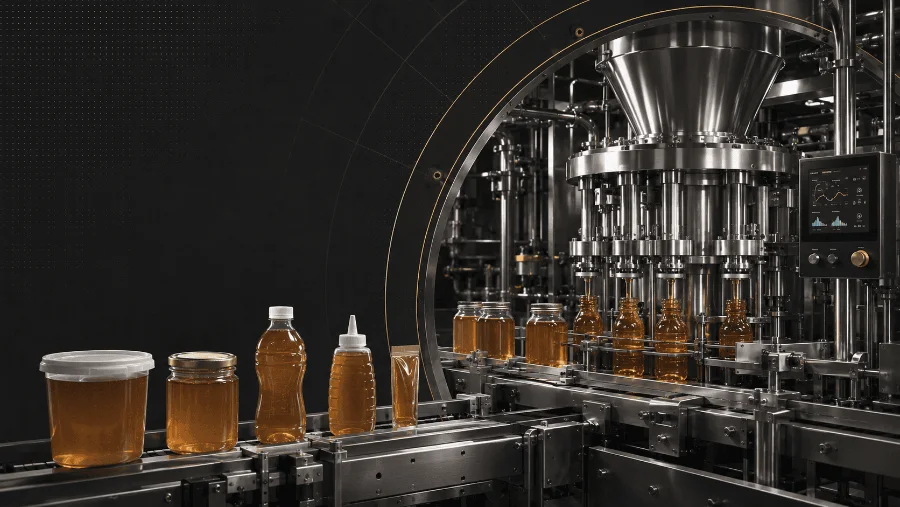
Honey is one of those products that looks trivial to package and is not. It resists flowing, it refuses to stop flowing cleanly, it thickens when the room cools, and it can change consistency partway through a run. General-purpose liquid filling equipment handles all of that badly, and the gap between a machine that suits honey and one that merely accepts it shows up in scrap, downtime and sticky caps rather than in the specification sheet.
This is a guide to writing the brief. If you want category sizing and forecast data, that is covered in our market analysis instead.
Temperature Is the Master Variable
How honey behaves at the nozzle depends almost entirely on how warm it is. Cooler product moves more slowly, resists the pump harder and throws your fill accuracy out; warmer product runs freely and drips more. Since your factory is not a laboratory, the temperature of the product path will drift with the ambient temperature of the hall unless something is actively holding it.
That is why heated hoppers and temperature-maintained product paths are standard on serious honey lines rather than optional extras. What you should specify is not simply that the hopper is heated, but where the control points are and how the temperature is held from tank to nozzle. Cold spots anywhere along that route become the point where product thickens and behaviour changes.
Ask the supplier to state the fill accuracy they will guarantee, and to state it at your product temperature and your viscosity rather than at a convenient one. An accuracy figure with no temperature attached to it is not a commitment.
Crystallisation Is an Equipment Problem
Honey crystallises over time and at lower temperatures, which means the product can change consistency mid-run and between runs. The equipment consequence is about geometry as much as heating: anywhere product can sit still is somewhere it will begin to grain and eventually cause trouble.
So look hard at dead legs, unswept corners, valve pockets and any section that cannot be fully drained at the end of a shift. Ask how completely the product path empties, whether it drains without dismantling, and what the procedure is when a batch arrives already partially crystallised. Those answers describe how much of your week you will spend on cleaning.
Cut-Off Decides Whether Your Caps Seal
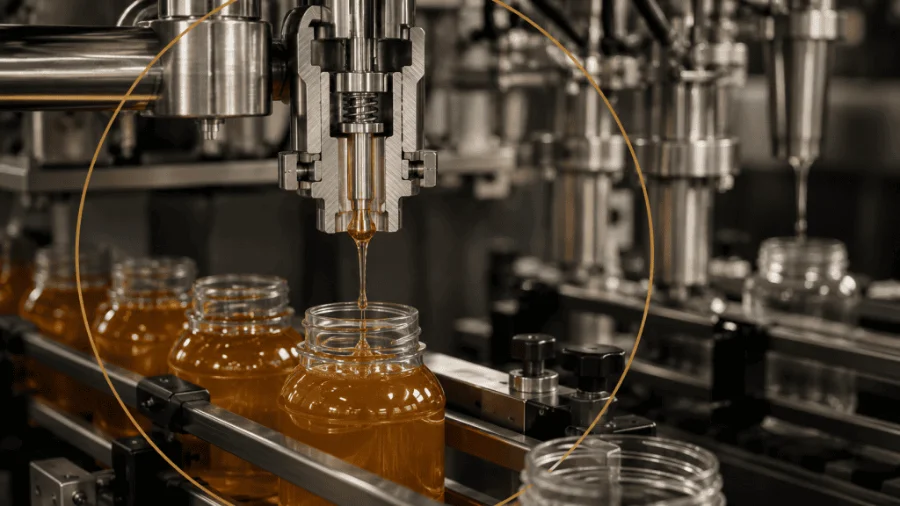
Stickiness is the property that costs money. Honey clings to the nozzle, runs down the outside of the container and strings out in fine threads instead of shearing off cleanly. Those threads land on the jar neck, and a closure applied over a coated rim does not seal dependably. What starts as a cosmetic issue at the filler becomes leaks in transit and shortened shelf life on the shelf.
The countermeasures are worth naming individually in a specification: a positive shut-off nozzle designed against stringing, suck-back at the end of the dose, dive filling where the nozzle descends into the container and rises with the level to limit splash and air entrainment, and a defined way of keeping the rim clean before capping and induction sealing.
Ask to watch the last three containers of a run and the first three after a restart. That is where cut-off problems appear, and it is not what a supplier will show you unprompted.
The Filler Type Follows the Viscosity
Gravity and flow-meter systems built for thin liquids struggle here, because honey does not obligingly flow under its own weight. Positive-displacement piston filling uses mechanical force to move product, which is what makes it the usual answer for high-viscosity food, and pumps and valves need to be sized for the resistance rather than for the volume.
Be specific with the supplier about the range you will run. Different floral sources, raw versus filtered, and blended versus single-origin all behave differently in the same machine, and a filler tuned to one may need reconfiguring for another. If creamed or set honey is anywhere in the plan, say so at specification stage – it is a materially different filling problem, not a recipe change.
The Container Decides Half the Line
The filler gets most of the attention, but container handling is where honey lines are actually won or lost. Each format brings a distinct set of demands on the machine around the filler.
| Format | Where it is used | What it demands of the equipment |
|---|---|---|
| Glass jars | Premium and organic ranges | Gentle handling under line pressure, and closure torque control |
| PET bottles | Mass retail | Stability of a light container, plus accurate capping |
| Squeeze bottles | Convenience retail | Drip control and a closure area kept genuinely clean |
| Tubs | Foodservice and bulk | Larger doses without slowing the line, and reliable lidding |
| Sachets and sticks | Single-serve and hospitality | Small-dose accuracy and a clean, uncontaminated seal |
Glass deserves particular attention. It chips, it is heavy, and it does not tolerate the accumulated line pressure that a plastic container shrugs off, so ask how containers are separated and controlled through the filling and capping stations. Single-serve formats sit at the opposite extreme: small doses have to hit tight tolerances, and any product on the seal area ruins the pack.
Giveaway and Underfill Are Both Expensive
Fill weight has to hold in both directions. Underfilled containers create a compliance exposure with the declared weight; overfilled ones give away margin quietly on every unit. Inline checkweighing that flags and removes out-of-tolerance containers before they leave the floor is the practical control, and it is worth understanding whether every unit is weighed or only a sample.
Do the arithmetic on your own numbers before comparing machines. A small average overfill across a year of production is usually a larger figure than most producers expect, and it belongs in the same comparison as the purchase price.
Changeover Is Where Premium SKUs Cost You
Adding varietal, raw, single-origin and organic lines is how brands grow in this category, and every addition means another format or size on the same equipment. Each one is a retooling that comes directly out of running time.
Organic and certified product adds a second layer. Batch numbers, origin documentation and testing records have to hold together well enough to survive an audit, which makes lot and date coding a functional requirement of the line rather than a finishing touch. Segregation between certified and conventional runs has to be procedurally clean and demonstrable, so ask what the changeover between them involves in practice.
One more thing to raise with a labelling supplier: adhesion. Labels have to stick to glass and PET even when a microscopic film of honey residue is present on the surface, which is a specification for the applicator and the label stock together.
Working Out What Size Line You Need
Take the units you have to ship in a week, divide by the hours the line will actually be available once cleaning and changeovers have been taken out, and hold suppliers to that figure rather than to a rated speed.
| System | Rated throughput | Where it fits for honey |
|---|---|---|
| Cup Fill & Seal | 30–120 cups/min | Portion cups, foodservice tubs and lidded containers |
| Form Fill & Seal | 100-300 units/min | Sachets and stick packs formed and sealed in line |
| Tray Sealers | Depends on tray size & format | Multipack and portion-pack presentations at end of line |
Bottled and jarred honey usually calls for a rotary or inline filler sized to your container mix, with capping and induction sealing immediately behind it. The point of the table above is the tempo of the line the filler has to keep up with, since a filler that cannot match its downstream equipment simply moves the bottleneck.
What Automation Changes on a Honey Line
What automation returns on a honey line is worth working out from your own figures rather than a headline number. With honey the mechanism is slightly different from most products, because so much of the manual cost is cleaning up after a process that was never quite controlled:
- Dosing – the same weight in every container, at a controlled temperature, without an operator adjusting for how the product feels.
- Cut-off and capping – clean rims into the capper, which is what stops leaks reaching a customer.
- Coding and labelling – lot, date and origin data applied automatically, which is what makes traceability claims defensible.
- Checkweighing and case packing – out-of-tolerance units removed before they are boxed rather than after.
E-commerce has raised the stakes on the second of those. A jar that once only had to survive a shelf now has to survive a courier network and a doorstep, and closure integrity is what carries it.
What to Make a Supplier Answer
- What fill accuracy do you guarantee at my product temperature, and how is temperature held from tank to nozzle?
- Show me the nozzle cutting off – and show me the first containers after a restart.
- Where can product sit still in this system, and how completely does the path drain?
- What keeps the rim clean between filling and capping?
- How is a certified organic run segregated from a conventional one, and what is the changeover?
- How are glass containers separated and controlled through filling and capping?
Insist that any trial uses your honey, not a viscosity-matched substitute. Stringing, residue and crystallisation behaviour are properties of the actual product, and a stand-in will not reproduce any of them.
Before You Sign Anything
Treat temperature control as the foundation of the specification rather than an accessory. Judge the machine on how it stops, not on how it runs. Ask where product can sit still, because that is where your cleaning hours come from. Give container handling the same scrutiny as the filler. And price your average overfill across a year before you decide which quote is cheaper.